Balkans, Anatolia, Caucasus, Levant and other Middle East, Iran, Afghanistan, South Asia, occasional forays into southern Italy, Spain or eastern Europe, minorities, the nation-state and nationalism — and whatever other quirks or obsessions lurk inside my head.
Bad translation. “Pодные”…”rodnye” means intimate, familiar, related; by extension born-beloved, dear one, cared for, same root in Russian as parents, birth, homeland, Christmas…wouldn’t be surprised if it has the same Indo-European roots as “root”.
Vitaly Mansky‘s documentary is being screened this coming weekend and the next at the Museum of the Moving Image in Astoria, Queens. (See schedule. It’s two train stops into Queens, guys. Then you can have a nice dinner for half of what you pay in Manhttan at a good friend and koumbaro‘s place: Mar’s.)
“In this follow-up to his award-winning documentary Under the Sun, filmmaker Vitaly Mansky examines Ukrainian society amidst the 2014 national election, a period rife with political chaos and growing uncertainty over national identity and integration. As both a Russian citizen and native Ukrainian, Mansky deftly underscores personal and political complexities as he visits with relatives living in Lvov, Odessa, the Crimean peninsula, and the Donbass region, and in the process discovers a wide and disorienting spectrum of outlooks and affiliations, including his own sense of ongoing exile and unease. Close Relations is at once an intimate family portrait and a graceful journalistic endeavor, a movie of the intense present that illuminates a place caught between a troubled past and an anxious future.”
Watch the trailer below.
Lots of moving, “disorienting” footage. Also, lots of humor, which reminds us that so much of a certain ironic, sardonic take on the world — a viewpoint “from a certain angle”, as E.M. Forster said of Cavafy — that we in the United States think is particularly Jewish, is really just a trait common to all eastern Europe, even Greece, or perhaps just a trait common to the powerless everywhere:
“Crimea was a pity, but the Donbass…they can have it.” *
But I think the most important moment in terms of geopolitics comes at 1:15:
“So Ukraine decided to join NATO. Isn’t that its own business?”
“Nyyyyyet!”
…comes the reply without a moment’s hesitation.
“Nyet” with its palatized “n” and final “t” is one of humanity’s great no-words. Like “yok” in Turkish, it literally means “there isn’t” or “Il n’y a pas”. But while “yok” has a kind of know-nothing passivity about it, “nyet” is an active “Halt! No way you’re going further down this road. There’s no access.” **
That moment in Mansky’s doc is why, despite widespread support for a Putin I find repulsive, I can’t get as angry at Russians as I get at Trump Americans and Türk-doğans; because Russians aren’t stupid. They’re not as smart as they used to be in the old days, при коммунизме, when everybody knew not to believe any-thing. They now believe all kinds of nonsense. And they went and got religion on me too, which is one of my life’s greatest watch-what-you-wish-fors. But they’re still pretty intelligent about the world.
I can’t get inside Putin’s head, like Ben Judah convincingly does in what’s still the best book on the Путинщина, the “Putin-ness” or the “Putin thang.” Judah’s thesis is that Putin is really just a nebech apparatchik who others put in his place and who now — having trampled over so many people on his way up — is terrified of stepping down and that the macho persona he so tiringly projects masks mega insecurity. It almost makes you feel sorry for him.
But this relative of Mansky’s and her coldly realpolitik “nyet” tell you why he has so many Russians’ support. Because it means: nyet, you can’t tell me that the U.S. and NATO suddenly developed a major crush on Estonia and Georgia; nyet, you can’t suddenly tell me you’re interested in Ukraine too, because this was already starting to feel like a corporate raid on all the old girlfriends who dumped me, but Ukraine, especially, is like hitting on my sister; nyet, you can’t moan and groan about how we’re violating a basic credo of the European Union by changing borders, when neither Russia or Ukraine are part of the European Union and you wouldn’t even have considered Ukraine — with its resources, access to the Black Sea and huge Russian population — a candidate if it weren’t a way to totally encircle Russia; and, nyet, you can’t tell us that you’re not still treating us with a Cold War mentality that you inherited from an Anglo tradition of Great Game power struggle that doesn’t apply anymore and is now completely counter-productive.
At least talk some truth and maybe we can get somewhere. And then I’ll reconsider breaking up with Putin.
In the meantime, we can try to think of everyone as “close relations.”
************************************************************************************* * The Donbass, the river Don basin is part of southeast Russia and the Russian-speaking parts of eastern Ukraine where the current conflict is centered. From “The first two of my cents on Ukraine and Russia“:
“Also, thence, a crucial point: that Ukraine wasn’t so much conquered, but settled by Russia…
“The independent “frontiersmen” mentality of the Russians of these areas, a sort of Russian Texas — among its ethnic Cossack peoples especially — should not be underestimated and should not be disregarded as a possible element in the current conflict. (See: And Quiet Flows the Don at Amazon and at Wiki.)”
“Новая Россия,” (Novaya Rossiya), New Russia, is not a Putinism. It’s a name for these lands that goes back to Catherine the Great and the first serious subduing of Cossack rebelliousness and settling of Russians in the region in the 18th century. It was part of the Russian empire’s most fertile grain-producing regions and then the scene of crazy industrialization under the Bolsheviks; maybe it was once a sort of “Russian Texas” but now it’s more like a sort of Russian Rust-Belt. Hence, the “they can have it” comment. The Soviet Army, decapitated by Stalin’s purges of its most talented and experienced, and ill-prepared and ill-equipped, only made the Nazi sweep through Ukraine grind to a halt once the Germans had made it this far east and after hundreds of thousands of Russian men had already been sent to a meaningless death and the Nazis had swept the old lands of the Pale clean of Jews through massive massacring and mass executions which were an integral part of the military strategy of the eastern front; many military historians believe that if the Nazi invasion of the Soviet Union hadn’t been slowed by German troops stopping every other community to round up and shoot its Jews (a method/process that killed more Jews than the gas chambers did), they might have been successful in beating the coming of winter and more successful in their campaign long-term. The region then became the scene of brutal attrition warfare, culminating in the siege of Stalingrad (now reverted back to its original name, Волгоград / Volgograd on map below). This left the region seriously trashed and so huge numbers of Russian workers were settled there post-WWII, Russianizing the Ukrainian far east even further and setting the stage for today’s conflict.
Map of the Don Basin. The grey line shows the border between Russia (РОССИЯ) and Ukraine (УКРАИНА) and the broken grey lines in Ukrainian east indicate the Lugansk (Луганск) and Donetsk (Донетск)
** “У меня денег нет” (“U menya deneg nyet”) in Russian is the same structure as the Turkish “Benim param yok” — “I don’t have any money.” Though Russian has a verb for “to have” like other Slavic languages, these structures both mean, literally: “By me there’s no money” or “My money isn’t there/isn’t by me.” Wondering whether it’s a construction Russian acquired through contact with Tatar. There is apparently a phenomenon where languages effect each other and transmit certain properties between them, though there’s no large bilingual population to bring them together and though they’re not genetically related, at least not closely. The absence of an infinitive, for example, in modern Greek, Albanian, Bulgarian and Romanian/Vlach, though each are from different Indo-European families and more closely related languages have an infinitive, is one good example. Also, Yiddish “by mir” (as in “By mir bist du shayn”) which is like the Russian по-моему (“according to me”) — for me, in my opinion. Though German uses “bei mir” also to mean same thing.
The most thuggish, corrupt sport on the planet chimes in on Catalan independence. Bloody everybody’s got an opinion.
Apparently there were rallies for a Basque referendum all over the Vascongadas in recent weeks as well, and soon the pendejito of Spanish regionalism, Galicia, will want independence too.
Is there anyone out there who knows of any studies of how European Union ideology and policy have supported regionalism and separatism in the past decades? That a German “go-ahead” on Slovenian and Croatian independence lit the fuse on the Yugoslav bomb has, I think, become a commonly accepted view in recent years, even for the most anti-Serb-minded Westerners. But is it the EU’s promise of support — meaning funds — what feeds these movements? i.e., is the idea: “If I have a direct line to Brussels then I don’t need Belgrade or London or Madrid” at the root of most of it? That would mean that Catalans are really not separatists but a form of closet centrists (which certainly proved true of Croatia); that they think they don’t need a tie to this parasitic peripheral center — Madrid — when they themselves can be parasites on a more central center, Brussels. Any thoughts?
And Brussels, of course, is not doing what it should be doing: telling Catalans that if they want out of the borders of a EU country then they’re out of the EU entirely, which is also the secret message that the West refused to send to Croatia in the 80s, sending it on its merry path with the consequences we all know of.
Something for all you enablers of Catalan delusions of grandeur who supported them with your tourist dollars over the past couple of decades to think about.
See Ryan Heath’s “Josep Borrell warns of Catalan ‘domino effect’“ in Politico (“The veteran Spanish Socialist politician — himself a Catalan — says that the independence argument is based on a myth.”)
I was once dragged by force into a corner by a Lebanese friend at a party in Cambridge and told to never ask anyone Lebanese their religious affiliation, I guess because I probably just had done. Of course, I still ask. Like I implied in my Turkish post a few days ago, pretend unity (that you’re a passionate Erdoğan supporter and I’m not, or if you’re Maronite and I’m third-generation Palestinian doesn’t mean that we can’t still be “unified”), can only become real unity if differences are acknowledged. (*1)
I’ve had not dissimilar experiences with Irish folks if I’ve ever tried to talk about religion orUlster or “the Troubles.” I once asked a guy at an Irish bar in Queens who was from Northern Ireland if he was Catholic, and I got a blank and frankly angry stare in response, and with so much alcohol and testosterone in the mix, realized quickly I should shut up and look the other way or change the topic. A female bartender who heard the one-sided exchange said to me softly: “not a good idea to ask people those things…” Ok.
Map of Northern Ireland with distribution of Protestants (red) and Catholics (green) according to age group, showing a clear demographic decline of Protestants.
I also hear Irish anger at what they think is an out of touch diaspora that funded continuing IRA violence when the Irish themselves on both sides were starting to get tired of the violence and the fences were starting to come down — though that’s slightly disingenuous — in the early days these diaspora funders were heroes — and, as a non-metropolitan Greek, immediately assuming that the “diaspora” is “out of touch” or stuck in a time warp is a seriously irritating train of thought; there’s lotsa ways we’re more in touch than you lot.
So I’m really setting myself up as an easy target since I’m not even Irish or Irish-American. But I feel I can’t be silent as the English decide the future of any part of Ireland again.
I know that the Brexit vote came as a shock to a lot of Americans, as we were forced to confront the fact that the English are not all that smart, and can be as jingoistic, xenophobic, ignorant and proudly “know-nothing” as Americans can be. And I say the English because Scotland and Northern Ireland voted against leaving the European Union — in Northern Ireland, particularly, in percentages that would indicate a large number of Protestants voted to stay as well — and they should now be free to decide their own fates free of London.
Sometimes I feel that my views on the ethnic nation-state and minorities come across as selective and sort of random to readers, so let me take this moment to clarify a bit. I am, of course, against the brutal assimilationist policies of the nation-state and a supporter of minority language and cultural rights. On the other hand, I’m also against a minority holding an entirely polity hostage because it refuses to conform with the conditions of living in a state where they don’t hold numerical superiority.
There’s a great and frustrating passage in Rebecca West‘s beautiful Black Lamb, Grey Falcon, where her Serbian (and half-Jewish) tour-guide is arguing with a Croatian intellectual in Zagreb; “but you are not loyal” says the Serb:
Croat: You treat us badly. How can we be loyal?
Serb: You’re treated badly because you’re not loyal.
Croat: How can we be loyal if we are treated badly?
Serb: If you were loyal, you wouldn’t be treated badly.
Croat: When you treat us better, we’ll be loyal.
Serb: As long as you’re not loyal you can’t expect to be treated better.
And on and on and on…
(Rebecca West, who along with disconcertingly smart and honest, was clearly a real babe as well — broke a lot of hearts and refused to forgive when hers was…cool. As Lauren Cooper would say: “Forgiving is for l-o-o-o-o-z-u-u-h-h-z-z!!!”)
Of course, we saw, during WWII, just after West’s second trip, and then again by the end of the last century, that Croatians had no intention of being loyal to Yugoslavia no matter how much bending-over-backwards to ‘treat them better’ Belgrade did.
Or take Catalans again, in a state where as a minority they are treated exceptionally well. Still, with full language and cultural rights, they feel Madrid is oppressing them and they want full independence, threatening to rip apart the fabric of a country that has made impressive democratic achievements over the past few decades. And those of you who bought the public relations crap about how “hip, cool and Mediterranean” Catalonia is, and who spend your tourist money in Barcelona and the Balearics have only contributed to the discriminatory tendencies of Catalan chauvinism and the worsening crisis of Catalan separatism. Try Galicia or the Basque Country if you want to see parts of Spain that are not part of the Castilian center, but where ethno-linguistic difference has made its peace with the Spanish state and society has agreed to co-existence. Or if they’re too rainy and un-Mediterranean for you, go to Córdoba and Granada (skip Seville, too Catholic and bull-obsessed), poorer parts of the country that need your money and where you can buy the public relations spin of Edward Said instead, who once outrageously made the claim that 60% of Spanish vocabulary is of Arabic origin, (or maybe the spin of Al Qaeda and ISIS) and wallow in Al-Andalus nostalgia.
Even more and very closer to home: my father’s Greek minority village of Derviçiani in southern Albania. My early-days romance with the village is kinna over and I feel free to express things that I’m angry at myself for not saying to the faces of people there earlier.
I’d love to ask: what the f*ck do you want exactly? They have Greek primary and secondary education; they have Greek churches (a Church about which few of them know anything or take seriously in any way, or have bothered to learn about in order to address the consequences of four decades of enforced atheism, but they have them); the Albanian Orthodox Church itself — meaning not just Greek minority churches, but the Church of Orthodox Albanians — in fact, is headed, run and staffed by Greeks, (extremely enlightened ones, I have to admit), the way the Arab Orthodox Churches of the Levant were for so many centuries; they have, I believe, two political parties that have members who sit in the Albanian parliament. If their villages are experiencing slow to rapid depopulation, it’s not the fault of Albanians or Tiranë; they were simply trapped — Greeks and Albanians together — in a Stalinist cage for fifty years and now are free to leave: the villages of Greek Epiros started hemorrhaging inhabitants soon after WWII, and neighboring Albanian villages, both Christian and Muslim, are also emptying of young people. Still, they’re hostile to neighboring Albanians; still, they want autonomy for “Northern Epiros,” which for some of them stretches half-way up to the middle of Albania (I don’t care if “the stones speak Greek all the way to Dyrracheio/Durrës” — The. People. Who. Live. There. Now. Don’t. And don’t want to be part of a Greek autonomous region. 2**); still, they make Muslim girls get baptized if they want to marry any of their precious boys, μη χέσω (thank God Albanians still wear their Islam kind of lightly or these poor girls would be in serious trouble) and will ostracize any Christian daughter or sister who falls in love with and marries a Muslim; still, they get offended, even a hip, British-educated nephew does, if you visit the pleasant, well-watered, historical Muslim village of Libohovo — Albanian Libohovë — across the valley and you come back and say it was very nice and that the young people there don’t seem much different than ours. Of course, this attitude is a self-fulfilling prophecy, as the conversation from Black Lamb… above indicates, so that when you put up the flag of Autonomous Northern Epiros 1914 on August 15th and the Albanian police has to come and take it down, then you’ll just end up on the bad side of the Albanian authorities and ordinary Albanians’ retaliatory instinct and the vicious cycle will just keep going.
A flag of the Youth of Derviçiani, which, just by wild and completely invented coincidence, happens to have been “founded” in 1914, the year there was a short-lived experiment in Northern Epiroteautonomy, which was squashed by Italian objections, because Italy considered Albania within its sphere of influence. Obviously not a sign of just the “youth” of the village — there was no Youth of Derviçani in 1914. And if there are still any doubts, the Palaelogan double-headed eagle lays them to rest.
(Really, is there anything as idiotic as a flag?)
But back to Ireland. I think Ulster Protestants caused enough “troubles” by acting — with the hypocritical support of England — like they were a besieged minority that couldn’t be part of the Irish Republic. So if a majority of Northern Irish voters chose to exit the Brexit, that’s a golden opportunity just dropped out of the heavens into our laps to correct an egregious historical wrong. The invasion and conquest of Ireland, its depopulation and the ripping to shreds of its society, culture and language did not start with the Potato Famine of the nineteenth century. It started with the Normans and the Plantagenets, and then the Tudors and the Stuarts and, finally, Cromwelland his Taliban, and it was a grueling, vicious, murderous process, as violent, or more, as any of Britain’s other colonial wars and right on Europe’s front door, and the Plantation of Ulster itself and the rest of Ireland was a conscious colonial policy of appropriating land and settling poor Protestant Scots and northern Englishmen in the country in order to “civilize” it and break Irish resistance to English hegemony.
If the above maps seem to indicate that a large number of Protestants left the Irish Republic in the twentieth century because they didn’t feel comfortable without the English crown’s protection, that’s unfortunate (it was not so unfortunate in cases where the Anglo-Irish elite felt they had to flee when their expropriated land was re-expropriated) but that can’t be a justification for the continued amputation of the country.
It’s a classic strategic move, though. Ulster Protestants are not a socioeconomic group comparable to the Anglo-Irish landowners; they were always as squire-ridden as their Catholic neighbors and are still pretty much on equal footing in that sense.
But everybody has to be better than somebody, or else you’re nobody. So, just like Catalans have to think they’re really Mare-Nostrum-Provençal Iberians (3 ***) and not part of reactionary Black Legend Spain; or Neo-Greeks have to think that they’re better than their Balkan neighbors (especially Albanian “Turks”) because they think they’re the descendants of those Greeks; or the largely lower-middle class, Low Church Anglican or Presbyterian or Methodist Brits who fled their socioeconomic status back home and went out to India in the nineteenth century in order to be somebody, had to destroy the socially laissez-faire modus vivendi that had existed there between Company white-folk and Indians, creating an apartheid and religiously intolerant, aggressively evangelizing, social system that laid the groundwork for the unbelievable blood-letting of the Indian Rebellion of 1857; or, perhaps history’s greatest example, poor whites in the American South(many, ironically, of Northern Irish Protestant origin) that had to terrorize Black freedmen back into their “place” because the one thing they had over them in the old South’s socioeconomic order, that they weren’t slaves, had been snatched away (and one swift look at the c-ontemporary American political scene shows clear as day indications that they’re, essentially, STILL angry at that demotion in status); or French Algerians couldn’t stomach the idea of living in an independent Algeria where they would be on equal footing with Arab or Berber Algerians. So Protestant Ulstermen couldn’t tolerate being part of an independent state with these Catholic savages.
A Bureau agent stands between armed groups of whites and Freedmen in this 1868 sketch from Harper’s Weekly.
Recent White supremacist rally at the University of Virginia in Charlottesville — thanks to @JuliusGoat: “Imagine if these people ever faced actual oppression.”
The colonial power — or just the colonized mind — then disingenuously but actively seeks to right these wrongs and protect the embattled minority. The results? A Lebanon torn apart by Maronite phobias and Palestinian victim-entitlement; the greatest threat to Spanish democracy since Franco; a Greece completely isolated from its nearest and closest — in every sense — neighbors; an India where British response to the Rebellion effectively disenfranchised Indian Muslims (4 ****) — Dalrymple shrewdly locates one of the beginnings of modern Islamic fundamentalism in that disenfranchisement and the Deobandi Islam it created 5 *****; the Ku Klux Clan and the murder of Emmett Till and Donald Trump; the vicious Algerian War of Independence, which resulted in French Algerians having to flee the country entirely to a France where they’re still a bulwark of reaction and racism, and the still bad blood between Algerian immigrants and natives in that country.
(I thought about adding Cyprus to that list, that’s going on forty-some years of division after the 1974 Turkish invasion, but didn’t, because Turkish Cypriots actually were an embattled minority, and Greek Cypriots have to do some moral self-searching about their terrorizing, or passively supporting the terrorizing, of their Turkish neighbors, before they blame either Turkey or the Greek junta for f*cking things up for them.)
I was against the Scottish independence referendum of a few years ago because I’m against separation and the putting up of borders generally. But then the apparently stoned British electorate went and separated itself from the rest of Europe, and if Scotland and Northern Ireland and Wales even, or Cornwall or the Isle of Manx or Jersey and Guernsey for that matter, want independence from England now, England will have only brought that down on its own head. If Northern Ireland votes to stay in the European Union then de facto reunion with the Republic will have occurred; I would just like de jure recognition of that facto too, so that there’s no more excuse for meddling in Irish affairs. Irishmen have done a lot of genuinely hard work confronting the demons of their own past in recent years; today’s Ireland is a democratic, pluralist, morally progressive society where the Catholic Church’s death-grip has been broken. That Ulster Protestants can’t live there in peace and security and without English protection is a ludicrous idea.
So let it happen, and if Ulstermen don’t like it — sorry to sound like a reactionary nativist — but they’re free to go back to Scotland where they came from. Or if they want they can come here and join their distant cousins in Kentucky and the Ozarks. I’m sure President Trump will consider them the “right” kind of immigrants.
1 * It’s a little reductive, but I think it’s not outrageously so to see the Lebanese Civil War as essentially, or initially, a conflict between Maronite demographic panic and paranoia (not entirely unjustified) and Palestinian entitlementof the oppressed (even more justified); every other group seems to then have had no choice but to choose sides. Then add Israel — which arguably started the whole problem — and Syria to the mix, και γάμησέ τα.
2 ** Of course, Northern Epirote Greeks’ δήθεν innocent desire for autonomy is completely disingenuous — though we’re supposed to think that Albanians are too stupid to get that — and is really just a prelude and first step to independence and union with Greece, though they’re a demographically fast-dwindling percentage of the population of the region they lay claim to. That’s not a deterrent, however; all you have to do is believe that all Orthodox Albanians are reeeeeeeally Greek and you’ve solved your demographic issue, since Muslim Albanians are just turncoat intruders in the region as far as Northern Epirotes are concerned.
The only obstacle that would then be left is to get Albanians to forget what happened to the Muslim Albanian Çams of western Greek Epiros (Albanian: Çamëria, Greek: ΤσαμουριάTsamouriá) during WWII, when they were subjected to massacre and expulsion in a campaign of ethnic cleansing by the Greek right-wing resistance and had to flee to Albania.
I still haven’t figured out how, as Muslims, they escaped the Greco-Turkish Population Exchange of the 1920s; it would’ve been a more merciful fate. I also haven’t figured out how the tsamiko, a dance of central and southern Greece, got its name. Or else, what clues to a forgotten past the fact that my grandmother’s maiden name was Çames provides; almost all our last names are Albanian — with the Greek male nominative -s ending added to them — as in Bako-s — but as far as I know there’s no clan in our villages whose last name is actually the name of an Albanian sub-ethnic group. See: (“Easter eggs: a grandmother and a grandfather“.
This kind of issue always reminds me of the Puerto Rican expression from a song of I dunno what period: “¿Y tu abuela donde está?” or “¿Y tu agüela, aonde ejtá?” “And where’s your grandmother?” i.e., before you get all high and mighty and Whitey on us, show us the Black grandmother you’ve got hidden in the kitchen.
3 *** This fetishizing of the Mediterranean as a region, a lost paradise of cosmopolitanism and healthy diets, drives me nuts. Everyone is suddenly “Mediterranean.” The big laugh, of course, is that Turks are Mediterranean. Then comes the less funny one about Croatians being Mediterranean, whereas Serbs are clearly not — Croats wanting to have it both ways, and be Mediterranean and Mitteleuropean at the same time — even if they’re from neolithic Herzegovina and about as neanderthal themselves as their Serbian and Muslim neanderthal neighbors; Istrians have sealed their Mediterranean-ness by buying every Italian restaurant in New York City’s boroughs, and of course the largely Italianate Dalmatian coast seals in most Europeans’ minds the idea of Croatia as a country on the f*cking M-E-D-I-T-E-R-R-A-N-E-A-N. Actually, the closest example to Croatians’ appropriation of a largely Venetian Adriatic is the Turkish appropriation of Greek Aegean imagery, in tourist and p.r. language, on both the Anatolian coast and in Imbros and Tenedos.
Just as nicely condescending is the saying from some-where in the Iberian periphery that “de Madrid no se ve el mar,” “you can’t see the sea from Madrid.” Supposedly a jab at Castillian casticismo, and inward-looking provincialness. No, you can’t see the sea. That’s why Castille is such a beautiful, high plateau, dry and bright and chilly and Romanesque and stunning in its emptiness and vastness.
A White Turk friend once dragged me to Sorrento on our trip to Naples and Campania, which I knew would be a mistake, because it would be and turned out to be a tourist-swamped, hellish Thomas Cook holiday trap because it was “on the sea.” (but one makes concessions to one’s travelling partner’s fantasies.) We cut out as soon as we could and headed to Ravello, up in the mountains away from the sea and she was blown away by how beautiful it was.
And what happens to Greeks like me? who are from a part of the Greek world that is clearly more Balkan in every way than it is Mediterranean? What do we have to do to join the club?
4 **** William Dalrymple is a great historical writer who does what professional academics can’t do because they’re so specialized that they can easily say: “Sorry, I don’t work on that period” when you ask them anything they don’t know. The breadth and depth of his knowledge on South Asia is truly amazing and he makes it all interesting and stimulating for the layman without dumbing it down. When I first started this blog I wrote to him asking to reproduce some of the passages on the British destruction of Mughal Delhi contained in his book, The Last Mughal, and he immediately and generously shot back with an email that said: “Go for it.” Thanks again.
“Following the crushing of the Uprising, and the uprooting and slaughter of the Delhi court, the Indian Muslims themselves also divided into two opposing paths: one, championed by the great Anglophile Sir Sayyid Ahmad Khan, looked to West, and believed that Indian Muslims could revive their fortunes only by embracing Western learning. With this in mind, Sir Sayyid founded his Aligarh Mohamedan Anglo-Oriental College (later Aligarh Muslim University) and tied to recreate Oxbridge in the plains of Hndustan.
“The other approach, taken by survivors of the old Madrasa i-Rahimiyya, was to reject the West in toto and to attempt to return to what they regarded as pure Islamic roots. For this reason, disillusioned pupils of the school of Shah Waliullah, such as Maulana Muhammad Qasim Nanautawi – who in 1857 had briefly established an independent Islamic state north of Meerut at Shamli, in the Doab – founded an influential but depressingly narrow-minded Wahhabi-like madrasa at Deoband, one-hundred miles north of the former Mughal capital. With their backs to the wall, they reacted against what the founders saw as the degenerate and rotten ways of the old Mughal elite. The Deoband madrasa therefore went back to Koranic basics and rigorously stripped out anything Hindu or European from the curriculum.*
*(It was by no means a total divide: religious education at Aligarh, for example, was in the hands of the Deobandis.)
“One hundred and forty years later, it was out of Deobandi madrasas in Pakistan and Afghanistan that the Taliban emerged to create the most retrograde Islamic regime in modern history, a regime that in turn provided the crucible from which emerged al-Qaeda, and the most radical and powerful fundamentalist Islamic counter-attack the modern West has yet encountered.”
See also his magisterial The Return of a Kingon nineteenth-century Afghanistan, which I have a few issues with, particularly his conclusions, but which was a couldn’t-put-it-down one for me.
This is a piece of graffiti that appeared in the Slovenian capital city of Ljubljana in 1992, at the beginning of the worst period in the Yugoslav wars and after Slovenia had become independent. “Burek [‘börek’ in Turkish, pronounced exactly like an umlauted German ‘ö’]? Nein Danke.” Burek? Nein Danke. “Burek? No Thank You.” What a silly slogan, ja? How innocuous. What could it possibly mean? Who cares? And how can NikoBako maintain the bizarre proposition that a piece of graffiti in a rather pretentious black-and-white photograph is an important piece, in its ugly, dangerous racism, of the break-up of Yugoslavia.
Back up then. There are certain — usually material — aspects or elements of Ottoman life in the Balkans, which, even for Christians in the region, despite the centuries of unfortunate hate and reciprocal bloodletting (and no, I don’t think pretending that wasn’t true or that “it wasn’t that bad” is the key to improving relations between us all now; I think the truth is the key), remain objects of a strange nostalgia and affection. They linger on — even if unconsciously, or even as they’re simultaneously an object of self-deprecating humour or considered homely backwardness – as evidence that Ottoman life had a certain refinement and elegance that these societies have now lost. You sense this often intangible and not explicitly acknowledged feeling in many ways. Folks from my father’s village, Derviçani, for example, now go to Prizren in Kosovo to order certain articles of the village’s bridal costume because they can no longer find the craftsmen to make them in Jiannena or Argyrocastro, and they’re conscious of going to a traditional center of Ottoman luxury goods manufacture. You feel it in what’s now the self-conscious or almost apologetic serving of traditional candied fruits or lokum to guests. Or still calling it Turkish coffee. Or in Jiannena when I was a kid, when people still had low divans along the walls of the kitchen where they were much more comfortable than in their “a la franca” sitting rooms. 1* Perhaps the sharpest comparison is the way the word “Mughlai” in India still carries implications of the most sophisticated achievements of classical North Indian…Muslim…culture, even to the most rabid BJP nationalist. 2**
There are some places where this tendency is stronger than in others. Sarajevo and Bosnia are obvious; they still have large Muslim populations though and, after the 90s, Muslim majorities. But Jiannena – which I’ll call Yanya in Turkish for the purposes of this post, the capital city of Epiros and one often compared to Sarajevo: “a tiny Alpine Istanbul” – is also one such place. Readers will have heard me call it the Greek city most “in touch with its Ottoman side…” on several occasions. You can see why when you visit or if you know a bit of the other’s past: or maybe have some of that empathy for the other that’s more important than knowledge.
About half Greek-speaking Turks before the Population Exchange, Yanya was a city the Ottomans loved dearly and whose loss grieved them more than that of most places in the Balkans. It’s misty and melancholy and romantic. It has giant plane trees and had running waters and abundant springs in all its neighbourhoods, along with a blue-green lake surrounded by mountains snow-capped for a good five or so months of the year. It experienced a period of great prosperity in the eighteenth and especially nineteenth century, when it was not only a rich Ottoman commercial city but also a center of Greek education: “Yanya, first in arms, gold and letters…” – and, especially under the despotic yet in certain ways weirdly progressive Ali Paşa, was the site of a court independent enough to conduct foreign policy practically free of the Porte and fabulous enough to attract the likes of Pouqueville and Byron, the latter who never tired of commenting on the beauty of the boys and girls Ali had gathered among his courtiers, as Ali himself commented profusely on Byron’s own. All the tradition of luxury goods associated with the time and the city: jewelry, silver and brassware, brocade and gold-thread-embroidered velvet, sweets and pastries – and börek – still survive, but are mostly crap today, even the börek for which the city used to be particularly famous, and your best luck with the other stuff is in the city’s numberless antique shops.
It also, unusually, and which I like to ascribe to Yanyalıs’ good taste and gentlenesss, has preserved four of its mosques, the two most beautiful in good condition even, and on the most prominent point of the city’s skyline. It would be nice if they were opened to prayer for what must be a sizable contingent of Muslim Albanian immigrants now living there — who are practically invisible because they usually hide behind assumed Christian names — but that’s not going to happen in a hundred years, not even in Yanya. Maybe after that…we’ll have all grown up a little.
And, alone perhaps among Greek cities, only in Yanya can one open a super-luxury hotel that looks like this, with an interior décor that I’d describe as Dolmabahçe-Lite, call it the Gran Serail, and get away with it. 3***
Digression Bakos. What’s the point? What does this have to do with Yugoslavia? I’m not digressing. I’m giving a prelude. “People don’t have the patience for this kind of length on internet posts.” I don’t post. I write, however scatterbrainedly. And not for scanners of posts. For readers. However few have the patience.
So. Croatians don’t eat börek. The prelude should have been enough for me not to have to write anything else and for the reader to be able to intuit the rest. But for those who can’t…
The graffiti on the wall in the photo at top is dated 1992, but I think it had appeared as a slogan as early as the late 80s when Slovenes and Croats started airing their completely imaginary grievances against Serbian domination of Yugoslavia and making secessionary noises. What it meant is that we, Hapsburg South Slavs, were never part of the Ottoman Empire and therefore never were subject to the barbaric and development-stunting influences of said Empire that Serbs and whoever those others that live south of them were, and therefore have the right to be free of the intolerable yoke of Serbdom. We don’t eat burek. Not only do we not eat burek, but you offer it to us and we’ll refuse in German – “Nein Danke” – just to prove how much a part of the civilized Teutonic world of Mitteleuropa we are. 4*** (I think it was Kundera who wrote about the geographical ballooning of “Central Europe” after the fall of communism, till “Eastern Europe” finally came to mean only Russia itself. ‘Cause as we now see, even Ukraine is part of Central Europe.)
Why this yummy pastry dish was singled out as a sign of Ottoman backwardness and not, say, ćevapi or sarma, I can’t say.
And when I talk about Hapsburg South Slavs I’m obviously talking about Croats, because, let’s face it, who cares about Slovenes? And there may be very few, if any, compelling historical or cultural reasons of interest to care about Croatians either, except, that as most readers must know by now, I consider them the people most singularly responsible for the Yugoslav tragedy. And this post is my chance to come clear about why I feel that way. There may be lots of interpretations of what the “Illyrianist” intellectuals of Vienna and Novi Sad and Zagreb had in mind when they started spouting theories of South Slav unity in the nineteenth century; countless theories about how Yugoslavia or the original Kingdom of the Serbs, Croats and Slovenes was formed; many analyses of what happened in Paris in 1919 and what kind of negotiations led to the Corfu Declaration; and reams of revisionist stuff written about exactly what Croatia wanted out of this union. But, for me, one basic fact is clear: that Croatians were always part of Yugoslavia in bad faith; that they wanted something out of the Serb efforts and Serbian blood that was decisive in defeating Austria in WWI, but that that something was independence, or greater autonomy within an Austria that they probably never expected to be dismembered the way it was – anything but what they felt was being subjected to Belgrade. And that became immediately clear upon the formation of the state when they – being, as Dame Rebecca calls them, good “lawyers” – began sabotaging the normal functioning of the Yugoslav government in any way they could, no matter how more democratic the Serbs tried to make an admittedly not perfect democracy, no matter how many concessions of autonomy Belgrade made to them. If there were any doubt as to the above, even when Radić and his Croatian People’s Peasant Party had turned the Skupština into a dysfunctional mirror image of today’s American Congress, even when a Macedonian IMRO activist working in tandem with Croatian fascists assassinated Serb King Aleksandr in Marseille in 1934, it was subsequently made brutally clear by the vicious death-spree Croatian, Nazi-collaborating fascism unleashed on Serbs during WWII, a true attempt at ethnic cleansing that dwarfs anything the Serbs may have done during the 90s — which is dwarfed again by what Croatians themselves did in the 90s again: the most heinous Nazi regime, “more royalist than the king,” as the French say — more Nazi than the Nazis — to appear in Eastern Europe during WWII. And they have not been even remotely, adequately, held to account by the world for any for any of the above; all this ignored, even as the West maintains a long list of mea-culpas it expects Serbs to keep reciting forever.
King Aleksandr of Yugoslavia (click)
And so, when they got their chance in the 90s, with the backing of a newly united, muscle-flexing Germany, Croatians abruptly and unilaterally and illegally declared their long-wished for (but never fought-for) independence. And so did Slovenia; but again, who cares about Slovenia? It was a prosperous northern republic that may have held the same Northern-League- or-Catalan-type resentments against a parasitic south that was draining its wealth, but it was ethnically homogeneous and its departure left no resentful, or rightfully fearful, minorities behind. But Croatia knew, when it declared its independence – as did, I’m sure, their German buddies – that they were pulling a string out of a much more complex tapestry. And did it anyway. And we all saw the results. 5*****
So when a Croat says “Nein Danke” to an offer of burek, without even the slightest concern about his past reputation and avoiding any German associations, it is for me a chillingly racist and concise summation of Saidian Orientalism, a slogan that sums up not only the whole ugliness of the tragic, and tragically unnecessary, break-up of Yugoslavia, but the mind-set of all peoples afflicted with a sense of their being inadequately Western, and the venom that sense of inadequacy spreads to everything and everyone it comes in contact with. I’ve written in a previous post about Catalan nationalism:
All of us on the periphery, and yes you can include Spain, struggle to define ourselves and maintain an identity against the enormous centripetal power of the center. So when one of us — Catalans, Croatians, Neo-Greeks — latches onto something — usually some totally imaginary construct — that they think puts them a notch above their neighbors on the periphery and will get them a privileged relationship to the center, I find it pandering and irritating and in many cases, “racist pure and simple.” It’s a kind of Uncle-Tom-ism that damages the rest of us: damages our chances to define ourselves independent of the center, and damages a healthy, balanced understanding of ourselves, culturally and historically and ideologically and spiritually. I find it sickening.
We’re signifying animals. And our tiniest decisions — perhaps our tiniest most of all – the symbolic value we attribute to the smallest detail of our lives, often bear the greatest meaning: of love; of the sacred; of a sense of the transcendent in the physical; of our self-worth as humans and what worth and value we ascribe to others; of hate and loathing and vicious revulsion. Nothing is an innocently ironic piece of graffiti – irony especially is never innocent, precisely because it pretends to be so.
And so I find anti-börekism offensive. Because a piece of my Theia Vantho or my Theia Arete’s börek is like a Proustian madeleine for me. Because I’m not embarrassed by it because it may be of Turkish origin. Because I think such embarrassment is dangerous – often murderously so, even. And because I think of eating börek — as I do of eating rice baked with my side of lamb and good yoghurt as opposed to the abysmally soggy, over-lemoned potatoes Old Greeks eat – as an act of culinary patriotism. 6****** And a recognition that my Ottoman habits, culinary and otherwise, are as much a part of my cultural make-up as my Byzantine or even Classical heritage are. Because just like Yugoslavia, you can’t snip out one segment of the woop and warf and expect the whole weave to hold together.
*1 One thing judo taught me — or rather what I learned from how long it took me, when I started, to learn to sit on my knees and flat feet — is how orthopedically horrible for our bodies upright, Western chairs and tables and couches are. (By couch here I don’t mean the sink-in American TV couch, which you sink into until you’re too fat to get out of — that’s another kind of damage.) Knee and lower back problems at earlier ages are far more prevalent in the Western world precisely because of these contraptions that artificially support and distort our body weight in destructive ways. I remember older aunts in Epiros, in both Jiannena and the village, being able to sit on a low divan on the floor and pull their legs up under their hips with complete ease — women in their eighties and nineties and often portly at that — because their bodies had learned to sit on the floor or low cushions all their long and very mobile lives; they looked like they didn’t know what to do with themselves when you put them in a chair. I’m reminded of them when I see Indian women their age at mandirs, sitting cross-legged, or with legs tucked under as described, through hours-long rituals, rising to prostrate themselves and then going down again, and then finally just getting up at the end with no pain and no numbness and no oyyy-ings.
**2 The two masterpieces of this point: the celebration of the sophistication and sensuality of the Ottoman sensibility and a trashing of Neo-Greek aesthetics — and by extension, philisitinism, racism and Western delusions — are Elias Petropoulos’ two books: Ο Τουρκικός Καφές εν Ελλάδι — “Turkish Coffee in Greece,” and Tο Άγιο Χασισάκι — “My Holy Hash.” Part tongue-in-cheek, part deadly serious, both books are both hilarious and devastating.
***3 Unfortunately, to build this palace of Neo-Ottoman kitsch that would make Davutoğlu proud, one of Greece’s classic old Xenia hotels, masterpieces of post-war Greek Modernism and most designed by architect Aris Konstantinidis, was torn down, and most of these hotels have suffered similar fates throughout the country, as the nationally run State Tourist Organization was forced to sell off its assets by the privatization forced on Greece then and to this day.
The Jiannena Xenia, above, built in the old wooded grove of Guraba, just above the center of town, and, below, perhaps Konstantinidis’ masterpiece, the Xenia at Paliouri in Chalkidike. (click)
Fortunately, Jiannena preserves one of Konstantinidis’ other masterpieces, its archaeological museum, below. (click)
****4 Ironically, the strudel that Croats and Slovenes imagine themselves eating in their Viennese wet dreams is probably a descendant of börek; and take it a step further: let’s not forget that croissants and all danish-type puff pastry items are known generically as viennoiserie in French. So the ancestor of some of the highest creations of Parisian/French/European baking arts is something that a Slovene says “nein danke” to in order to prove how European he is. Talk about the farcicalness of “nesting orientalisms.”
*****5 Of course, in every case, this assumption-cum-accusation, about the parasitic South draining the North of its resources, is patent bullshit. Southern Italy, the southern Republics of Yugoslavia, Castille, Galicia, Andalusia, and the southern tier of the European Union today, may get disproportionately more in the allotment of certain bureaucratic funds compared to the tangible wealth they produce. But they also provide the North, in every single one of these cases, with resources, labor and markets on which that North gets rich to a far more disproportionate degree and stunts the South’s growth in the process. So haydi kai…
It’s become a common-place — and not inaccurate — observation that the catastrophic economic pressure Germany is today exercising on the nations of Southern Europe for the sake of making some sick moral pointis the fourth time it’s wrecked Europe in less than a century — the third time being when it decided, immediately upon reunification, to show the continent it was a political player again by practically single-handedly instigating the destruction of Yugoslavia.
******6
Over-oreganoed and over-lemoned — like much of Greek food — and overdone, over-salted and over-oiled, perhaps the only thing more repulsive than the soggy potatoes Old Greeks bake with lamb or chicken (though one horrible restaurant — which New Yorkers are for some reason crazy about: I mean like “take-the-N-train-out-to-Astoria-and-wait-for-a-table-for-an-hour” crazy — criminally serves them with grilled fish) is the serving of stewed meat with french fries. You’ve hit the rock bottom of Neo-Greek cuisine when you’ve had a dry, stringy “reddened” veal or lamb dish accompanied by what would otherwise be good, often hand-cut french fries, sitting limply on the side and sadly drowning in the red oil.
These are börek in Sarajevo being baked in a gastra, a strange piece of High Ottoman technology that is still used in much of northern Greece, especially Epiros and the rest of the Balkans, particularly the western parts: Albania, Montenegro (where uniquely in the Serb-speaking world, they call börek pitta like in Greek), Kosovo and southern Serbia — regions, interestingly enough, where börek is a particularly strong regional identity marker and the object of a powerful cult of affection and snobbery. Every and each börek in these parts is subjected to intense scrutiny; is there too much filling (major demerit points because you’re obviously trying to make up for the poor quality of your phyllo/yufka); is each layer fine enough, but able to both absorb serious quantities of butter and not get soggy, like a good croissant or a good paratha. Finally, that you use real — and good — butter, which makes almost all commercially sold varieties not worth trying, since using good butter on a commercial scale would make a börek that is prohibitively expensive, and especially in a country of culinary philistines like Greece, store-bought versions are almost inedible, as is most product in Turkey these days too, Turkish street food having suffered a marked decline in quality even as the tourist literature on the country continues to rave about it. But I have had good börek in Macedonia, in Mavrovo, and in Montenegro, in Žabljak, where the hotel made us a great cheese and a great cabbage one for a hike we went on. And in a high-end restaurant in Jiannena too; but next to me was an Albanian woman, who first smelled it, pricked at it with her fork, counting the layers of pastry, and then after a few minutes of just staring at it, pushed it away in disgust. Like I said, it’s an object of great snobbery. And forget Old Greece. It’s a standard rule of thumb that the further away in place and time a region of Greece is from the Ottoman experience, the exponentially worse the food gets. No one south of Larissa can bake a pitta to save their lives, or make a decent plate of pilav for that matter. Epiros is probably the only place you can still get a nice buttery mound of pilav — like the kind Turks make — with good yogurt. Southern Greeks seem allergic to rice, and have friggin’ potatoes with almost every meal. Maybe It’s a Bavarian thing — I dunno.
But everything baked tastes better in a gastra, the same root as the word for “womb” in Greek (or “gastritis”): rice and lamb, even zeytinyağlı vegetable dishes. It’s just incredibly tedious — and dangerous if you don’t know what you’re doing — to use. It’s a cast-iron dome, suspended with a very complicated chain mechanism over a stone platform. You first lift the dome and light your charcoal fire underneath it on the stone platform. When the fire has been reduced to hot embers, and the cast-iron dome has also gotten nice and hot, you brush the embers aside, position your tepsi of food, lower the hot cast-iron dome, and then pile the still glowing embers on top of the dome. Usually when they’ve cooled down completely the dish is done. The picture above shows gastras at all steps in the process.
I dunno really. Does it make that much of a difference? Everything is better when it tastes slightly smokey or when a little bit of ash has fallen into it — like Turkish coffee made in hot ashes. But it’s a ton of work and really impractical. If, for example, the embers go out completely and you raise the dome and the food isn’t done yet, you have to start the whole process from the beginning. Arthur Schwatrz, in his ever-best cookbook on Neapolitan food, Naples at Table: Cooking in Campania — which, like most good cookbooks these days, is as fantastic a source of history, anthropology and ethnography as it is of good recipes — says that a lot of foods legendary for how long you had to cook them for them to be the “real” article, like a Neapolitan ragù (pronounce with a double “r” and a “g” that sounds like a light Greek “gamma” – “γ”) that should take at least half a day to simmer or no self-respecting Neapolitan would eat it, were never really cooked that long. Rather, they were cooked on wood fires and braziers, which were constantly going out, had to be relit, while the sauce cooled off and took time to reheat, etc. Of course, for certain sauces and stews, and the fatty, sinewy cuts of meat we like in “our parts,” this kind of cooking is ideal. And not just the slow, long heat, but the cooling off and reheating especially.
(click)
It’s like that other piece of Ottoman high-tech (I don’t mean to make fun, but it wasn’t exactly their strong suit), the mangal home-heater or charcoal brazier. (above) You’d pile charcoal into it; leave it out in the street until the carbon monoxide burned off, then cover the embers with the lid and bring the whole incredibly dangerous, glowing — and often very large — brass behemoth inside to warm the house, or one hermetically sealed room really. Then, as my mother used to describe it, you’d get under the blankets or flokates, facing the mangal, so your face would turn all red and sweaty while your back was freezing, and hope you had fallen asleep before it started cooling off or that you had generated enough body heat under the blankets to last till morning. There were countless stories about families being found dead in the morning, because in the rush to bring this silly contraption into the freezing house, the carbon monoxide often hadn’t burnt off entirely and people would die from poisoning in their sleep. I can only imagine that their use was required because it was probably tricky to build chimneys in mostly wooden Ottoman urban housing — my mother only remembered them from Jiannena; in her village where the house was stone, there were regular stone fireplaces where you could keep adding wood because the chimney would let the smoke and gas escape — and I’m sure that many of the massive fires that consumed whole mahallades of Ottoman cities over the centuries and killed thousands on certain occasions, were probably caused by one accidentally knocked over mangal somewhere.
And whole neighborhoods would burn down and then be rebuilt in wood again, something I comment on in another post — “Macedonia: Sveti Jovan Bigorski“:
This is a kind of Ottoman tradition: build in wood, suffer repeated fires like the kind that wiped out whole districts of Istanbul throughout its history and killed tens of thousands. Then rebuild in wood again. It’s not known who said that the definition of neurosis is repeating the same action over and over and expecting a different result, but it also might be the definition of stupidity. Only after a fire destroyed two thirds of Pera in 1870 in just six hours did people in those predominantly Christian and Jewish areas start building in masonry, which is why those neighborhoods are architecturally far older today than those of the now ugly two-thousand-year-old city on the original peninsula, where there is almost no old domestic architecture left (except, again, in former minority neighborhoods, for some reason, like Fanari or Balata or Samatya).
More on the symbolics of börek and the break-up of Yugoslavia in the next post.
The Valley of Dropoli, the pass up to the Pogoni plateau near Libochovo, and in the distance, the snowcapped peaks of Nemerčka, from the Monastery of the Taxiarches in my father’s village of Derviçani, Easter 2014 (click)
I’m honored by the fact that this really intelligent blog quotes extensively from the Jadde’s mission statement in a recent post: “Jadde — Starting off — the Mission.“
The author of the post below and the person I suspect is largely behind the editing of the blog is one Eoin Power, not just a fellow Balkan-freak along the lines of me or Rebecca West, but also a fellow Epirote. He demurs a bit — though not very convincingly — at being called an Epirote, because his lineage is multiple and complicated and the connection to Epiros is fairly distant historically. But he’s from one of the most archetypically and ancient Epirotiko villages — where they still own their patriko — in one of the most archetypically Epirotiko regions of Epiros and he carries himself with the requisite Epirotiko dignity and soft-spokeness and if I, NikoBakos, have conferred the title on you, it’s ’cause you deserve it.
The other day, as she is wont to do, my mother sent me a link to something on the Internet; this time it was to Nicholas Bakos’ blog, which you can find here. If you’re reading this blog, we’re probably friends in real life (thanks for reading!), and so it’s probably obvious why something like that would be of interest to the both of us. I have admittedly only skimmed sections of his posting so far, but in his introductory one, it was especially gratifying to read this:
This blog is about “our parts.” It’s about that zone, from Bosnia to Bengal that, whatever its cultural complexity and variety, constitutes an undeniable unit for me. Now, I understand how the reader in Bihać, other than the resident Muslim fundamentalists, would be perplexed by someone asserting his connection to Bengal. I can also hear the offended screeching of the Neo-Greek in Athens, who, despite the experiences of the past few years, or the past two centuries, not only still feels he’s unproblematically a part of Europe, but still doesn’t understand why everyone else doesn’t see that he’s the gurgling fount of origin and center of Europe.
But set aside for one moment Freud’s “narcissism of petty differences,” if we have the generosity and strength to, and take this step by step. Granted there’s a dividing line running through the Balkans between the meze-and-rakia culture and the beer-and-sausage culture (hats off to S.B. for that one), but I think there’s no controversy in treating them as a unit for most purposes; outsiders certainly have and almost without exception negatively. And the Balkans, like it or not, include Greece. And Greece, even more inextricably, means Turkey, the two being, as they are, ‘veined with one another,’ to paraphrase the beautiful words of Patricia Storace. Heading south into the Levant and Egypt, we move into the Arab heartland that shares with us the same Greek, Roman-Byzantine, Ottoman experiences, and was always a part of the same cultural and commercial networks as the rest of us. East out of Anatolia or up out of Mesopotamia I challenge anyone to tell me where the exact dividing line between the Turkic and Iranian worlds are, from the Caucasus, clear across the Iranian Plateau into Afghanistan and Central Asia.
Bakos suggests that for people of “those parts” displaced to another environment (e.g. grad school in the West), this kind of geographical unity came, at least in a social context, fairly naturally, so perhaps I shouldn’t be all that surprised and delighted at seeing it reconstituted in blog form. But in fact I think the basic unity of the geographical zone outlined here often gets lost in the way these places are understood by outsiders and, ironically enough, in no small part due to the vehement insistence from each of the zone’s component peoples that they could not possibly be compared with those uncultured idiots with whom they share a border.*
Explaining the rationale for delineating “his parts” the way he does, Bakos writes:
But to step into Buddhist Burma is somehow truly a leap for me, which maybe I would take if I knew more. And in the other direction, I stop in Bosnia only because for the moment I’d like to leave Croatia to Europe – mit schlag – if only out of respect for the, er, vehemence with which it has always insisted that it belongs there. Yes, I guess this is Hodgson’s “Islamicate” world, since one unifying element is the experience of Islam in one form or another, but I think it’s most essential connections pre-date the advent of Islam. I’ll also probably be accused, among other things, of Huntingtonian border drawing, but I think those borders were always meant to be heuristic in function and not as hard-drawn as his critics used to accuse him of, and that’s the case here as well.
Ultimately what unites us more singularly than anything else, and more than any other one part of the world, is that the Western idea of the ethnic nation-state took a hold of our imaginations – or crushed them – when we all still lived in complex, multi-ethnic states. What binds us most tightly is the bloody stupidity of chilling words like Population Exchange, Partition, Ethnic Cleansing – the idea that political units cannot function till all their peoples are given a rigid identity first (a crucial reification process without which the operation can’t continue), then separated into little boxes like forks after Easter when you’ve had to use both sets – and the horrendous violence and destruction that idea caused, causes and may still do in “our parts” in the future.
Having not, at least north of the equator, yet made it further east than Istanbul, I am in no position to question Bakos’ perception of the fundamental apartness of Buddhist Burma. But the loose border he posits to the north and west is one I’ve crossed many times, and it’s one that is both deeply present and functionally invisible.**
At the very least it is present in people’s minds; I can vouch for the vehemence (to use Bakos’ word again) with which Slovenes and Croats will insist that their countries are European, and not Balkan. It’s also pretty visually observable – you could mistake Zagreb or Ljubljana for a city in Austria or Germany in a way you simply can’t for, say, Sarajevo or Belgrade. And on one frantic trip from Dubrovnik back to Ljubljana (the ferry which I’d intended to take from Dubrovnik to Ancona decided not to arrive from Split, leaving me nothing to do but beat a hasty retreat back north) you could, if you were looking for it, see an actual tangible difference in the way things were done in the world – bus tickets in Mostar and train tickets in Sarajevo had to be paid in cash and a conductor on the train north from Sarajevo let me pay in a mix of Croatian kuna, Bosnian marks, and euros. In Zagreb I could pay with a credit card, the train station had working and appealing amenities, and you couldn’t smoke in the train. This is a terribly squishy thing to write, but it did feel more “European-y”.
On the other hand, if the relatively old Huntingtonian dividing line between formerly Orthodox and Ottoman lands to the south, and formerly Catholic Hapsburg lands to the north is visually (and, at least in terms of credit card viability in 2009, functionally) discernible, the comparatively recent unifying experience of Yugoslavia is also unavoidable. Here, too, the first signs are in architecture and appearance; Soviet-style architecture and the legacy of 1950s industrialization has left the same physical scars on cities from Nova Gorica to Skopje. But they run deeper than that – the protestations of linguistic nationalists notwithstanding, Slovene, Bosnian, Croatian, Serbian, Montenegrin, Macedonian (hell, even Bulgarian a bit) all exist along a spectrum of of mutual intelligibility; state apparatuses, all having those of the former Yugoslavia as their common predecessors, share similar characteristics. Indeed, to me as a foreigner, the similarities often seem more salient than the differences.
Just on the basis of whether or not there “is” a usefully differentiating border to be drawn where Croatia meets Bosnia, it seems you can argue fairly fruitfully either way, depending on whether your sympathies lie with a sort of longue duree emphasis on deep civilizational splits or a faith in the primacy of modern political experiences. But by Bakos’ own ultimate criteria, it seems a bit odd to leave the northernmost bits of the former Yugoslavia out of things (though there is a nice alliterative symmetry to covering “from Bosnia to Bengal”) . If you’re going on the basis of, “the bloody stupidity of chilling words like Population Exchange, Partition, Ethnic Cleansing,” surely things like Jasenovac or the Istrian exodus argue for the inclusion of all of the former Yugoslavia?
Of course, any exercise in boundary-izing is a bit arbitrary, and in this case there are good reasons to put one in between Croatia and Bosnia and not, say, in between Slovenia and Austria (two countries for which there also exist plenty of historical reasons to consider them as part of a unified space). So if all of this does anything, it is perhaps to show how much more liminal are most places than we or their inhabitants often care to admit; whether or not you see a border somewhere often depends as much on your level of zoom as anything else.
*Or at least their nationalist politicians – many average people (whatever that means) in Bosnia and Serbia, for example, will quickly stress to you the fundamental similarities between the two countries and their inhabitants **People sometimes marvel at my overstuffed passport but really something like 40% of the stamps come from the Dobova and Dobrljin border posts.
…fuels imaginary grievances and rejects solidarity. It divides and discriminates. And it defies the essence of democracy: respect for diversity. Complex identities are a key feature of modern society. [my emphasis] Spain is no exception.”
A brilliant op-ed piece from the Times today by Mario Vargas LLosa, among others, that exposes all the petty narcissism and destructiveness of the orgy of separatist movements that Europe has seen come to the fore in the past few decades: “A Threat to Spanish Democracy .”
Other money quotes:
“In their attempt to undermine the workings of the constitutional government, Catalan separatists have displayed a remarkable indifference to historical truth. Catalonia was never an independent state. It was never subjected to conquest. And it is not the victim of an authoritarian regime. As a part of the crown of Aragon and later in its own right, Catalonia contributed decisively to making Spain what it has been for over three centuries: an impressive attempt to reconcile unity and diversity — a pioneering effort to integrate different cultures, languages and traditions into a single viable political community.
“Compared with the crises occasioned by the collapse of dictatorships in many European states, Spain’s transition to democracy, following the 1975 death of Francisco Franco, was exemplary, resulting in a democratic constitution granting broad powers to Spain’s autonomous regions. Yet Catalan separatists have glossed over the positive aspects of the transition.”
and:
“But the advent of democracy brought official recognition to Spain’s distinctive cultures, and set the foundations for the autonomy the Catalans enjoy today. Catalonia has its own official language, its own government, its own police force. Catalans endorsed the Constitution overwhelmingly: 90 percent of them voted yes in the referendum of Dec. 6, 1978. The millions of tourists who flock to Barcelona every year, drawn by the beguiling blend of Gothic and Gaudí, attest to the vigor of Catalonia’s culture. The claim that Catalonia’s personality is being stifled and its freedoms oppressed is simply untrue.”
The piece pretty much says it all: the bogus democraticness of separatist rights and the supposed right to self-determination completely debunked as nothing more than “little” nationalisms, which as Vassily Grossman points out in this post “…the nationalism of little nations,” can be just as dangerous and certainly as small-minded as that of “bigger” nationalisms. Ditto this op-ed for Abkhazia, South Ossetia, Ukraine (both sides), for Belgium, Scotland and, of course, for the most nightmarish manifestation of these tendencies in our time, the tragic break-up of Yugoslavia. And that’s without even going as far back as the Partition of India, or the Greco-Turkish Population Exchange of the 1920s.
“Complex identities are a key feature of modern society.” No, no and no… Complex identities are not just a key feature of modern society, but humanity period, a feature of pre-modern society since the beginning of time. The roughly two centuries of modernity or “the modern,” which we can probably date from the French Revolution on, is the only period in history when the ethnicity-based nation-state and its brutal, levelling, anti-humanist attempt to “de-complicate” human identity held sway as the predominant form of sociopolitical organization. It’s just a blip on the screen of history and will soon come to be seen as such. Multiple cultural identities and stable state political organization can co-exist easily. Thinking otherwise is an idea whose burial is long overdue.
So, what irritates me most about separatist movements like that of the Catalans is that they’re really retrograde ideologies disguised as liberation movements. Since the Barcelona Olympics of 1992, when the autonomous Catalan government had the impudence, I remember, to plaster New York City subway cars with ads that read “Catalonia is a country in Spain,” (???) Catalans have been engaged in a massive public relations campaign to project an image of sophistication, liberalism, bogus hipness, and artistic innovation (including culinary — if you can actually call the molecular nonsense Ferran Adrià put out food…) all meant to be juxtaposed against a clichéd, “Black Legend” stereotype of Spain — under whose repression Catalonia suffers — that’s just plain racist. Catalan nationalism rests mostly on the laurels of its Republican-ness and struggle against the forces of Spanish reaction in the 1930s — Hemmingway and Orwell’s “Homage.” But the attitude of today’s average Catalan nationalist more resembles that of the average member of Italy’s Northern League, a far-right if not quite fascist but certainly racist bunch of jerks: the same smug sense of superiority towards their co-citizens and the same petit bourgeois self-righteousness about how their wealth and resources get sucked up by the parasitic rest of the country.
There is no convincing evidence that Catalan society is any more liberal or open or sophisticated than the rest of Spain. See González Iñárritu‘s film “Biutiful” (if you can bear to watch it; I couldn’t make it though a second viewing…but it’s the perfect antidote to Woody Allen’s nauseating “Vicky, Cristina, Barcelona”), for how much better Catalonia treats its immigrants, for example, including those from poorer parts of Spain, than any other part of Europe, or do some reading up on the discrimination Castillian-speakers in Catalonia suffer. Catalan independence is not a liberal or liberatory idea; it’s exclusionary and elitist to the core. The problem is that most of the world falls for the discourses of these movements –the way the West did with Croatia in the 90s — because they’re so good at playing victim.
The finger-flipping at the impressive democratic achievements of Spanish society since 1975 is particularly galling.
See this story from the Times: “Putin Urges Talks on Greater Autonomy for Eastern Ukraine,” which I’m pretty sure was his objective to begin with: force a crisis to get so bad and then negotiate for autonomy. What repercussions that will have for Ukraine’s future or what patterns it’ll set for other areas (like the Baltic countries — Putin’s most vociferous critics — or Central Asia) of the former Soviet/Russian sphere that contain large Russian minorities has to be seen.
Belgravia Dispatch had an excellent and frighteningly prescient opinion piece on the escalating Ukrainian crisis back in March: “What To Do–And Not Do–About Ukraine“ — which, unfortunately, the whole world ignored and whose worse case scenarios have now come true, including the annexation of Crimea and what I think it is now safe to call a full-scale invasion of Ukraine by Russian forces and not just a rebel movement of local Russian separatists.
One important point from me, first and up front: the West can rush to get tough on Russia if it wants to; I can guarantee you that Russians are tougher. This is a point that Gregory Djerejian on Belgravia makes and one that has certainly manifested itself in exactly the way he predicted. We need to remember that this generation of Russians that has come of age since the momentous changes of the nineties are the first generation in that people’s history, perhaps, to not have been dragged to hell and back at least once in their lifetime. They’re proud — rightfully, I feel — of their capacity for survival. This isn’t an expression of support on my part for Putin’s cheap machismo: my loathing for him and his posturing, his whole persona and everything he represents — including the craven adulation of him that is Russians at their most infantile — is something I’ve written on endlessly. It’s just stating a fact that the West should be aware of: they’re not going to be pushed around. Think hard before you put them in a position where they have to prove that to you…because they will. So treating Russia like a pariah will only play into Putin’s hand. That’s, in fact, what has happened; the whole country has fallen in line behind him and anything like the РОССИЯ БЕЗ ПУТИНА — “Russia without Putin” — protests of two years ago would be considered, in a spontaneous act of socially unanimous censoring, pure treason these days with no one even daring to publicly air such opinions in the current heady climate of nationalist excitement.
The other point is one that Belgravia makes right off the top of his post with the following quotes:
“Yet, Kievan Russia, like the golden days of childhood, was never dimmed in the memory of the Russian nation. In the pure fountain of her literary works anyone who wills can quench his religious thirst; in her venerable authors he can find his guide through the complexities of the modern world. Kievan Christianity has the same value for the Russian religious mind as Pushkin for the artistic sense: that of a standard, a golden measure, a royal way.”
–Georgy Fedotov
“The problem of the origin of the first Russian state, that of Kiev, is exceedingly complex and controversial.”
–Nicholas Riasanovksy
“Without Ukraine, Russia can remain an empire, but it cannot remain Russia.”
–Title of a recent article in Russkoye Obozreniye, a Russian periodical.
It’s like Scotland.
This was one of the first things you would’ve realized if you were on the ground in Russia this July and August like I was (but despite my suggestions to several industry friends and acquaintances, no Western journalists seemed to think that the “story” was not just in Donetsk or Luhansk, but in living rooms and at kitchen tables in Moscow and Petersburg and countless other places): that is that Russians simply don’t consider Ukraine a foreign country or foreign culture. I’m not making a judgement call on whether that’s right or wrong or imperialist on their part or not; judging such sentiments “ethically” or putting them through the political-correctness grinder is pointless and counter-productive. It’s just that their historical experiences have led Russians — and arguably, till a certain point, had led most of the people who now call themselves Ukrainians — to think that way: that they were both intimately and inseparably related, and there’s as much point in calling those feelings “wrong” as there would be in your therapist telling you that your neuroses are “wrong.” And so Russians were/are, in fact, in shock that the rest of the world thinks it has no role to play in Ukraine or no vital interests in political developments there. The reason that this doesn’t seem to register in Western consciousness is a result of the fact that the West is so immersed in thinking along an ethnicity-based nation-state model of discrete national units with clear, essentialized, historical trajectories, that it is incapable of seeing nationalism as a construct: flexible, malleable, unclear, even “made-up-as-you-go-along” if you will — so that Russians, and the new Ukrainian nationalists, can have radically opposing views on what their relationship is, without either of them being “wrong.” As brilliant a historian as Timothy Snyder, author of the devastating “Bloodlands: Europe between Hitler and Stalin“ is capable of writing in The New Republic this past May, in an article called: “The Battle in Ukraine Means Everything“ the following:
“Ukraine does of course have a history. The territory of today’s Ukraine can very easily be placed within every major epoch of the European past. Kiev’s history of east Slavic statehood begins in Kiev a millennium ago. Its encounter with Moscow came after centuries of rule from places like Vilnius and Warsaw, and the incorporation of Ukrainian lands into the Soviet Union came only after military and political struggles convinced the Bolsheviks themselves that Ukraine had to be treated as a distinct political unit. After Kiev was occupied a dozen times, the Red Army was victorious, and a Soviet Ukraine was established as part of the new Soviet Union in 1922.”
Snyder’s history — “of course” — with its suggestion of a straight, uninterrupted historical lineage of “Ukrainian-ness” from Kievan Rus’ to modern Ukraine is just patent bullsh*t, and is one that simply chooses, in the glossing-over-of-breaks-and-ruptures fashion and in the fabricating of false unities that nationalist narratives always engage in, to ignore several fundamental, historical realities: one, the fact that the Russian principalities that rose up in the northern forests of what we now consider the Russian heartland after Kiev’s demise at the hands of the Mongol-Tatars — Vladimir, Pskov, Novgorod and later Moscow and its unifying power — were more highly conscious of their political descent from early mediaeval Kiev and were, in fundamental ways, far more its true political and cultural and spiritual heirs than any “Ukrainian” polity could even try to claim to be until the twentieth century; two, that most of what is now Ukraine had already been part of Russia for more than two centuries before the Bolshevik revolution; and that, three, before that, the western quarter of it, maybe, was Polish and then Austrian, while much of the rest — through “every major epoch of the European past…” — was just a frontier no-man’s-land, a coming-and-going corridor for nomadic peoples either conquering or fleeing someone else. (You can find a place for each and every corner of the world in “every major epoch of the European past” if you want to; that doesn’t mean it was central or even remotely important to that past.) Also, thence, a crucial point: that Ukraine wasn’t so much conquered, but settled by Russia, while Snyder’s quote taken on its own makes it sound like an eternal Ukraine, populated by a people who had always thought of themselves as solidly and eternally Ukrainian, was just subjugated by the Soviet Union in the twenties.* So it ignores all the ways that “Ukrainian-ness,” a term that did not even come into common usage until the late nineteenth and early twentieth centuries, was the product of a complex negotiation and mixture of different sub-identities converging from different directions in those fertile flatlands and has always, in that sense, been bound up in a million intricate ways with the history of its larger kin-nation to the north. But we’re making the same mistake I believe we made in Yugoslavia: seeing the “nation” as something essential and essentialized, first and foremost; and secondly, assuming that the nationalism of the powerful player — in this case Russia, in the Yugoslav case, the Serbs — is pathological, inherently oppressive and dangerous, while ignoring the fact that the nationalism of the “little” — in these cases, Ukraine, and in Yugoslavia, that poor, powerless victim, Croatia — can not only be just as venomous and illiberal and murderous, but is often more so because it has a point to prove or a chip on its shoulder. But the West is so in love with what by now should be the completely discredited Wilsonian idea of “self-determination” (while simultaneously supporting the “inviolability” of national borders**) that it fails to see that dark truth. I’ll probably need to get into greater historical detail in another post in order to clarify a bit better.
(And now I’m ready for the barrage of accusations that all I ever do is knee-jerk defend my Orthodox brethren, but that’s cool — just par for the course.)
History, climate, geography have always conspired to isolate Russia. And, in a sense, the pathos that drives Russian history and is the force behind her brilliant civilizational achievements (and, yes, her imperialism too), is that of a constant, heroic struggle to break out of that isolation and find her place in the larger world. Yacking on, like Snyder, about how Ukraine is somehow “essential” and central to the very idea of Europe, when, ironically, the very name Ukraine means “the edge” (from the same Indo-European cognate as the Greek “άκρη”…height or edge as in acropolis, or as Serbian “Krajina”). The edge of what? of Russia/Poland…the EDGE of Europe…what an elevation of status Snyder grants to a proverbial Podunk, while treating Russia as dispensable or as a dangerous threat that needs to be hemmed around and contained — isolated again — is criminally unfair to Russians (if not to Putin and his cronies) and will end up backfiring on the West in ways it hasn’t even begun to anticipate. Russia is not dispensable. Nor is she to be ignored or patronized. We think of her in those terms and the results will just get uglier and messier.
* There’s even a subtle subtext to the narrative of the Revolution and subsequent Civil War that Snyder gives us, which suggests some kind of identity between Ukrainian-ness and White Russian resistance to the Bolsheviks, when, in fact, I think that if the White Russian movement can be said to have had an ethnic or regional “base,” it was among the Russians of eastern Ukraine (the grandfathers of these very separatists of today? I wouldn’t know…) and the neighboring parts of southeastern Russia that stretch to the Caucasus. The independent “frontiersman” mentality of the Russians of these areas, a sort of Russian Texas — among its ethnic Cossack peoples especially — should not be underestimated and should not be disregarded as a possible element in the current conflict. (See: And Quiet Flows the Don at Amazon and at Wiki.)
** The contradiction between the ideas of self-determination for peoples and the inviolability of borders — a contradiction that can’t be avoided if we keep thinking in terms of the EBNS (ethnicity-based nation-state) — has plagued do-gooder Western policies in all parts of the non-Western world from Wilson and Paris till Helsinki and still does. And this despite the fact that its randomness and practical inapplicablity have been made so obviously clear on so many occasions: if Croatia can secede from Yugoslavia, why can’t Krajina Serbs secede from Croatia? If Ukraine deserves — has an inalienable right — to be a country independent of Russia, then why doesn’t its overwhelmingly Russian eastern parts have an inalienable right to be independent of Ukraine? Obviously it just comes down a particular bias of the West at a particular time
As for where it all started, Crimea, I hate to report to outraged Western observers that of all parts of Ukraine, Crimea was always the area with a practically non-existent Ukrainian element in its population. Not that the March “referendum” was not a total farce. But if any people have a right to Crimea and to feeling displaced and dispossessed it’s Crimean Tatars — not Ukrainians. Hell, just to play Devil’s advocate…the millenia of Greek presence on the northern shores of the Black Sea, and the numerous Greek mercantile communities that existed in Crimea and around the Sea of Azov until the twentieth century (Chekhov attended a Greek elementary school in Taganrog), give even us a technically greater ethnic claim to Crimea than it does to Ukrainians.
In any event, I knew as far back as the early nineties, that sooner or later Russia would find a way to take Crimea back (Crimea was part of the Russian Soviet Republic until 1955) and am actually surprised it took so long. The drang nach süden impulse that drove Russian imperial policy for hundreds of years — the equivalent of American “Manifest Destiny” — south into Ukraine and on to the Black Sea, with the ultimate objective of a re-Orthodoxed Constantinople and Russia as a Mediterranean and world super-power with access to India and the East, was not a desire for the rich soils of the Dnieper valley. It was a need for access to warm weather ports. Crimea thus became a crucial site for the base and deployment of Russian and then Soviet naval power and there was no way that it was just going to be handed over so casually. Ask the United States to just hand over Camp Pendleton and Twenty-Nine Palms, the naval bases at Coronado and Loma Catalina, along with the whole San Diego metropolitan area, to Mexico. Or just grant Hawaii its independence. Or give it to Japan. Or try, even, just to get the U.S. to close its base in Okinawa! It’s the same thing. Is this an apology for imperialism? No. It’s just a statement of a historical and political reality that can’t be ignored. Or one that it’s necessarily the West’s business to “fix.”
Note: The Ukrainian national case or argument may have one key point that is rarely discussed and is surprising to me in that sense. I’m not certain of it, but it may be that eastern Ukraine acquired its overwhelming Russian ethnic character because it was the region hardest hit and left most depopulated by Lenin and Stalin’s murderous collectivization disaster, and that many Russians were settled there afterwards when the region was turned into one of the industrial heartlands of the Soviet Union. This is seriously guessing on my part and someone with greater knowledge should be sought out for a definitive answer.
A corollary to that is the hypocrisy of western Ukrainians, the most fanatical nationalists and quasi-Catholics, and perhaps the most extreme element on the Ukrainian political stage today (whom Putin uses, of course, to paint all Ukrainian nationalists as fascists and Nazi collaborators), who did not suffer any of the horrors of collectivization and famine because they were under Polish rule at the time — not always so benign either — and only became part of the Soviet Union in 1945. Yet, they use those events as some of the main tools in their anti-Russian arsenal. Furthermore, just as many Russians suffered during those violent socioeconomic processes and it’s a slightly cheap appropriation to call them a purely Ukrainian set of humanitarian disasters.
Of all the victims of the Population Exchange, and among all descendants of muhacir groups in Turkey generally, probably few are as fanatical in the maintenance of their collective identity or memory of their homeland than Turkish Cretans — which only proves that they’re as Cretan as any Greek Cretans are. And which my saying probably enrages certain nationalist “intellectuals” in Athens I know more than it does Cretans themselves.
Around the corner from my apartment, there’s a taverna owned, obviously, by a Turkish Cretan, which he’s named “Giritimu.” This is a combination of “My Crete” in Turkish: “Giritim” — and Greek: “Κρήτη μου,” “Crete mou” — which is what the Greek-speaking Turks of the island, who constituted a third of its population until the twentieth century, would have used anyway — into one odd, bilingual, double possessive. And it’s corny, but half the times I walk by I tear up at the sight of it anyway.
A thousand curses on the kathikia who thought they could treat people like cattle this way. But you know what? A thousand more on the heads of those peoples themselves, who gave the kathikia politicians and diplomats the raison for doing it, by not being able to live together without being at each others throats for an eternity, and now cry for their lost homelands and are all mushy-gushy love for their lost “brothers.” Whenever a Turk tells me “we’re brothers,” half the time I want to cry and hug him and half the time punch him. (See: “After the Floods, Unity and Compassion” for what’s become a growing sentiment on my part recently.)
One night I’ll stop by and eat there, just to honor the memory.
Djokovic’s Greatest Motivation Isn’t on Court By CHRISTOPHER CLAREY MAY 26, 2014
PARIS — Novak Djokovic was safe and dry after his first-round victory at the French Open on Monday, and it was noted that he often seems to play his best when he is playing for a cause higher than tennis.
“You’re right; you’re right,” he said. “It’s an interesting observation. I did also feel this at times when I had the last couple of years certain kinds of situations in life, good and bad, that were a lesson in a way for me. I noticed that I found that extra motivation to perform well on the court and to go far.”
But can he go all the way here over the next two weeks and join an exclusive seven-member men’s club by winning the only Grand Slam singles title he is missing? Playing for Serbia has been a powerful motor for Djokovic. An emotional run to the 2010 Davis Cup title, Serbia’s first, helped him make the leap from serial Grand Slam contender to serial Grand Slam winner in 2011. Wojtek Fibak, the former Polish star who advised Djokovic at last year’s United States Open, said he used that for fuel again when Djokovic was upset after his semifinal with Stan Wawrinka was scheduled first during the day after he had played primarily night matches.
Fibak said Djokovic had “the worst warm-up” and was in “a horrible mood” so he tried his best to get him back to the essential. “I said, ‘Remember your parents, remember your father had to sell his car for you to play tennis,’ ” Fibak said. “I kept bringing it up, and Novak’s eyes were big, and I said: ‘Do you know why they did it? So you could play the U.S. Open, and now you are in the semis of the U.S. Open and you don’t want to fight and you’re not happy just because of the time? I said do it for your father, your mother, for Serbia.’ And Novak all fired up now goes, ‘Serbia! Serbia!’ ”
He went on to beat Wawrinka in five sets before losing to Nadal in the final.
Now, as he returns to the tournament he wants to win more than any other, Serbia is again at the forefront of his thoughts. He has been seriously involved in raising money and awareness for relief efforts after this month’s floods in southeastern Europe, primarily in Serbia and Bosnia and Herzegovina, that killed dozens and forced hundreds of thousands from their homes. Djokovic has donated his prize money — listed at 549,000 euros, or $750,000 — from winning the Masters 1000 event in Rome.
“I’ve seen the images and followed the news every single day, and it was something I’ve done because I felt like that was the right thing, and that’s it,” Djokovic said. “The second thing I thought about was that it was going to attract more of the donors from the international world to see that the situation is as serious as the prize money I donated. We’re talking about billions of dollars needed.” Several players from the region took part with Djokovic in an on-court show of solidarity during an exhibition day at Roland Garros before the tournament. It was a small yet deeply symbolic gesture. Croatia, Serbia and Bosnia were all part of Yugoslavia before war broke the country apart in the 1990s. But Djokovic said that if there were any upside to this, it would be that former antagonists were now cooperating.
“To be honest there is something that I did not predict, did not expect,” Djokovic said. “And that is the solidarity of the people of the three countries that were in conflict only 15 years ago. That’s something that was incredibly moving and very encouraging for the relationship for the future of these people, because maybe we cannot be the same country again. Maybe people are thinking that’s not a good idea, but there is definitely a lot more room for improvement of the respect and solidarity between the people.”
When he is serious, Djokovic speaks in long paragraphs. He makes less eye contact than in his earlier days, but what remains remarkable is his ability to shift tone in a hurry. On Monday, marooned on a bench on a changeover during a second-set rain delay at Roland Garros, he invited the ball boy holding his umbrella to join him on the bench for a chat. He then finished off Joao Sousa, 6-1, 6-2, 6-4. In a news conference, he doubled over with laughter and put his head on thedesk when an Italian journalist asked Djokovic, who eats a gluten-free diet, if adopting the same regimen would help him improve his writing.Moments later he was discussing the floods again and then, moments after that, answering a query about Boris Becker, the former champion who is coaching Djokovic this year along with his longtime coach Marian Vajda.
Becker won every Grand Slam tournament except the French Open and never won a professional clay-court title, which makes him an intriguing choice of mentor. What kind of advice might Becker be giving him for the French Open?
“He doesn’t tell me to serve and volley, that’s for sure,” Djokovic cracked. “But you know on a serious note, he is still one of the most successful players to play the game even though he hasn’t won Roland Garros.”For Djokovic, Becker’s experience in big matches and big events is precious cargo even if he failed to win the Australian Open with him in his camp and has had most of his big victories this year with only Vajda in attendance. But the whole team was together in Rome.
“I feel that we understand each other much better already since Rome,” Djokovic said of Becker.
For now, Djokovic remains, with Becker, one of the best men’s players never to win the French Open, a list that includes John Newcombe, Jimmy Connors, John McEnroe, Stefan Edberg and Pete Sampras. But in light of Djokovic’s excellence on the surface, he may now be the best men’s clay-court player in the Open era never to win it.
Djokovic has won Rome three times and Monte Carlo and Madrid once. At Roland Garros, it took Roger Federer in full flight to stop Djokovic in the semifinals in 2011. It took Nadal in full fight to stop him in a rain-interrupted final in 2012 and then again in last year’s classic five-set semifinal.
Beating Nadal at Roland Garros remains the toughest task in tennis, and Djokovic said that the death of his grandfather inspired him in 2012, just as the death of his childhood coach Jelena Gencic in the midst of last year’s tournament inspired him before he fell just short, losing by 9-7 in the fifth.
“I cannot say that the images and memories of these people were not in my head while I was playing but I tried to channel this energy and information in the positive direction,” he said. “And I knew both of these people who were very supportive of my career would like me to play and win for them, so that’s something I had in the back of my mind.” There is much more for the back of the mind this year. There are Serbia and its neighbors. There is his coming marriage to Jelena Ristic and the birth of their first child later this year.
“It’s true; I have plenty of causes right now,” he said with the second round on the horizon.
Balkans, Anatolia, Caucasus, Levant and rest of ME, Iran, South Asia
Me, I'm Nicholas Bakos, a.k.a. "NikoBako." I'm Greek (Roman really, but when I say that in English some five people in the world today understand what I'm talking about, so I use "Greek" for shorthand). I'm from New York. I live all over the place these days. The rest should become obvious from the blog.

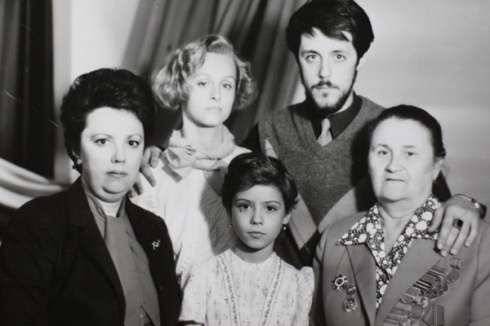
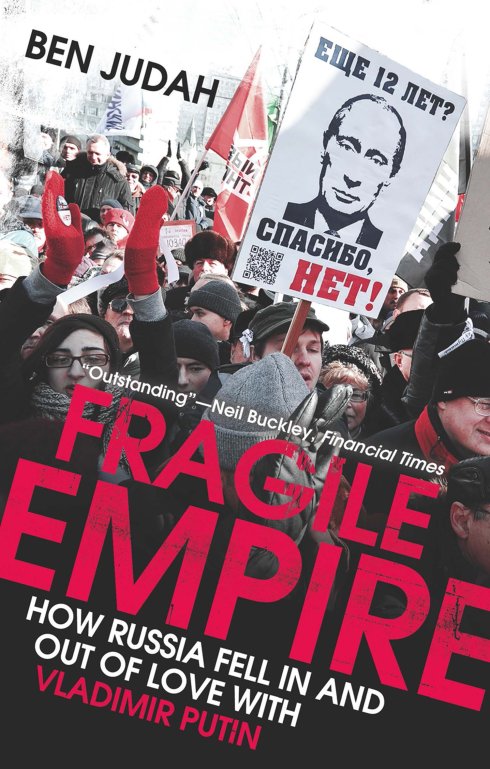
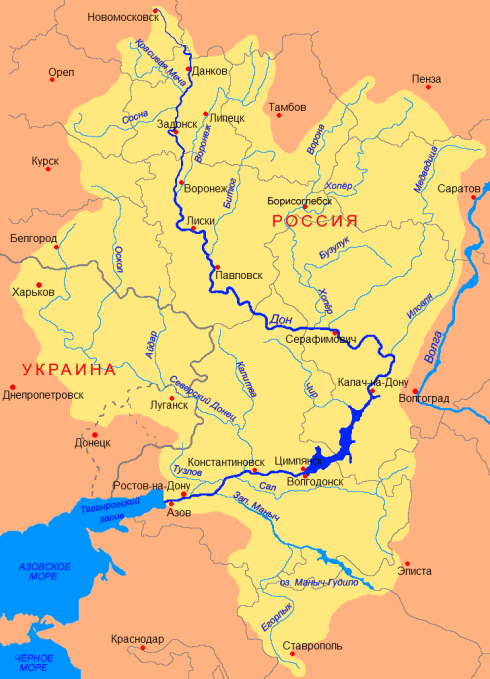
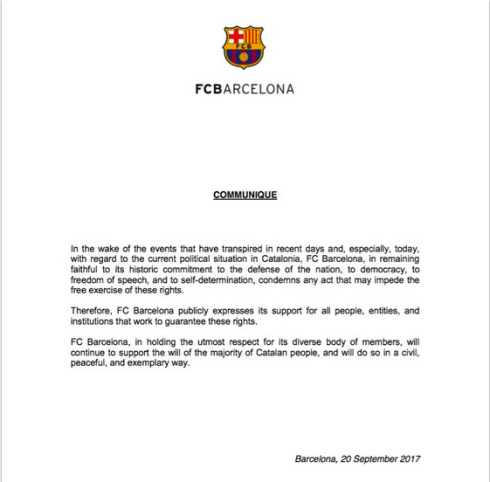

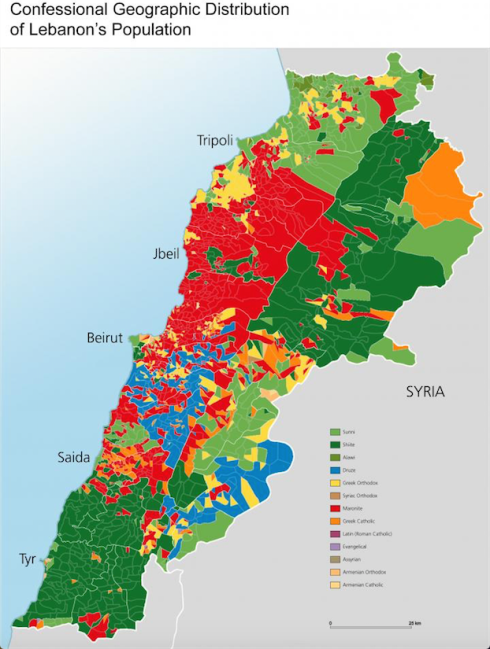
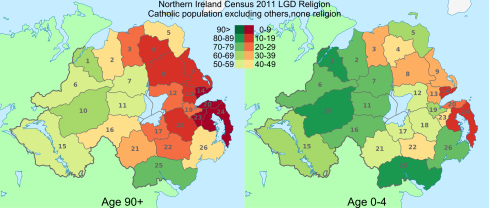 Map of Northern Ireland with distribution of Protestants (red) and Catholics (green) according to age group, showing a clear demographic decline of Protestants.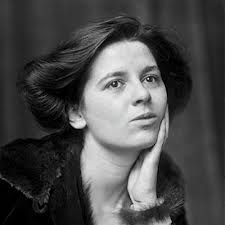
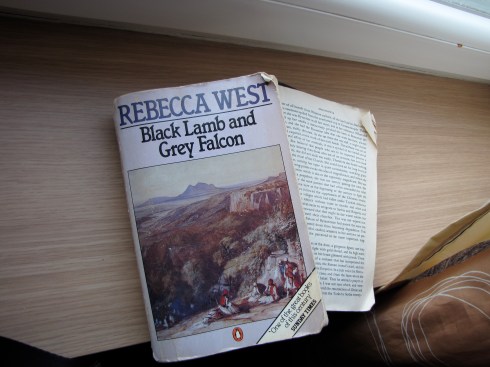
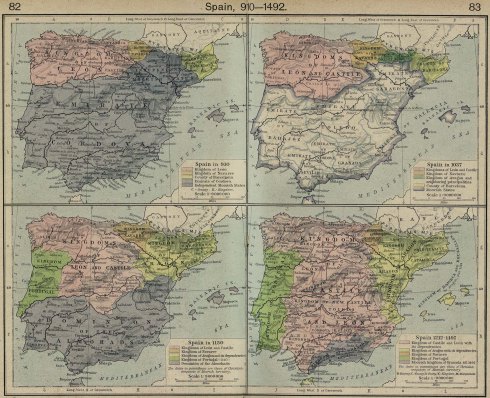
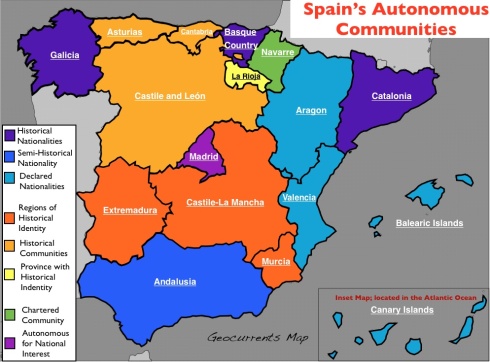
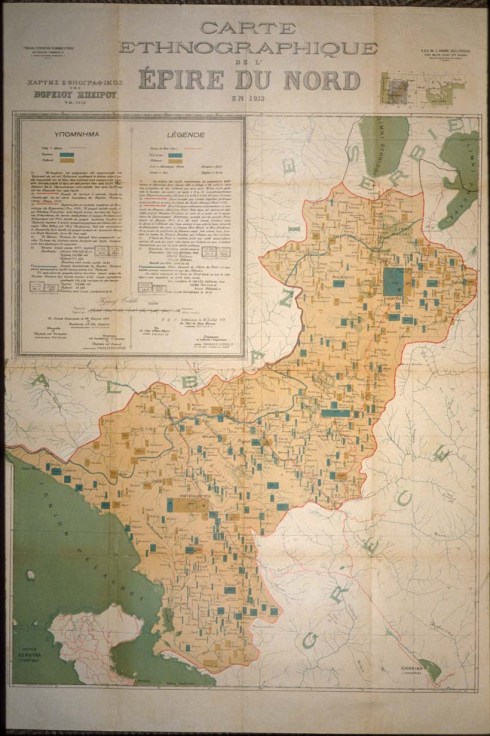
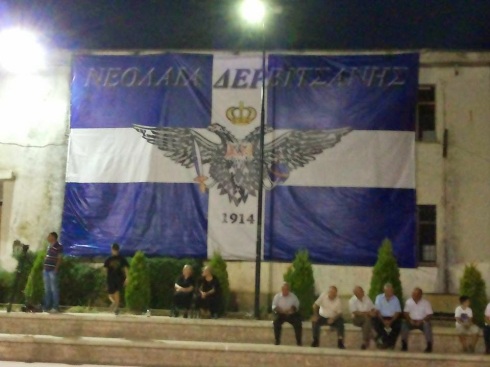
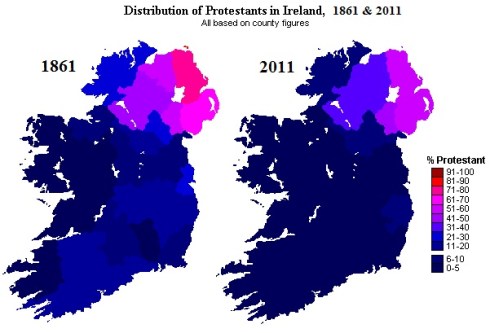
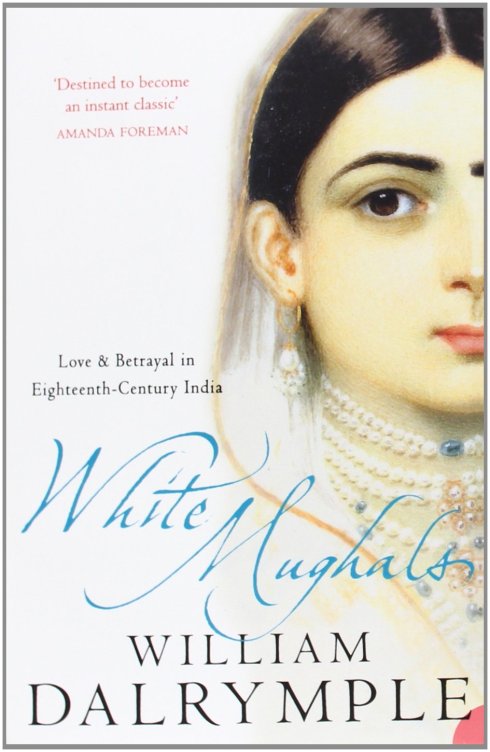
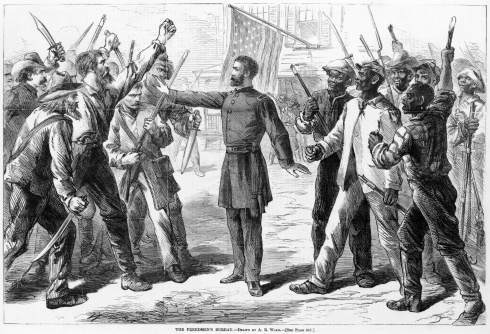 A Bureau agent stands between armed groups of whites and Freedmen in this 1868 sketch from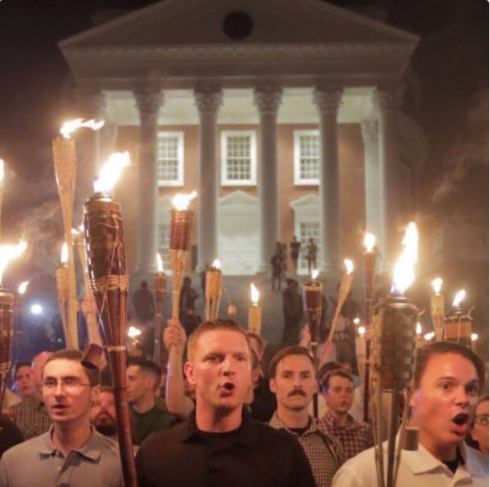
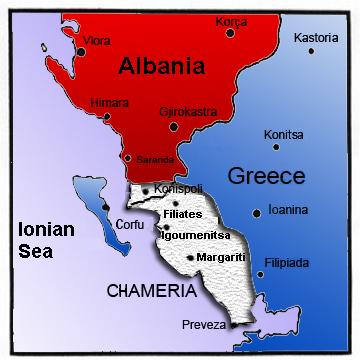
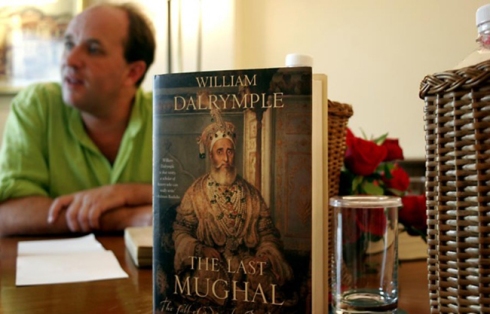
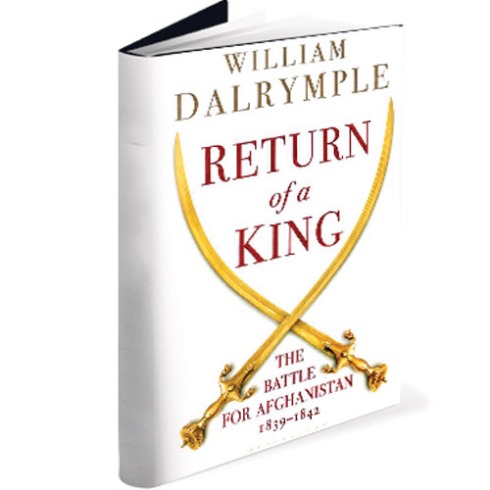


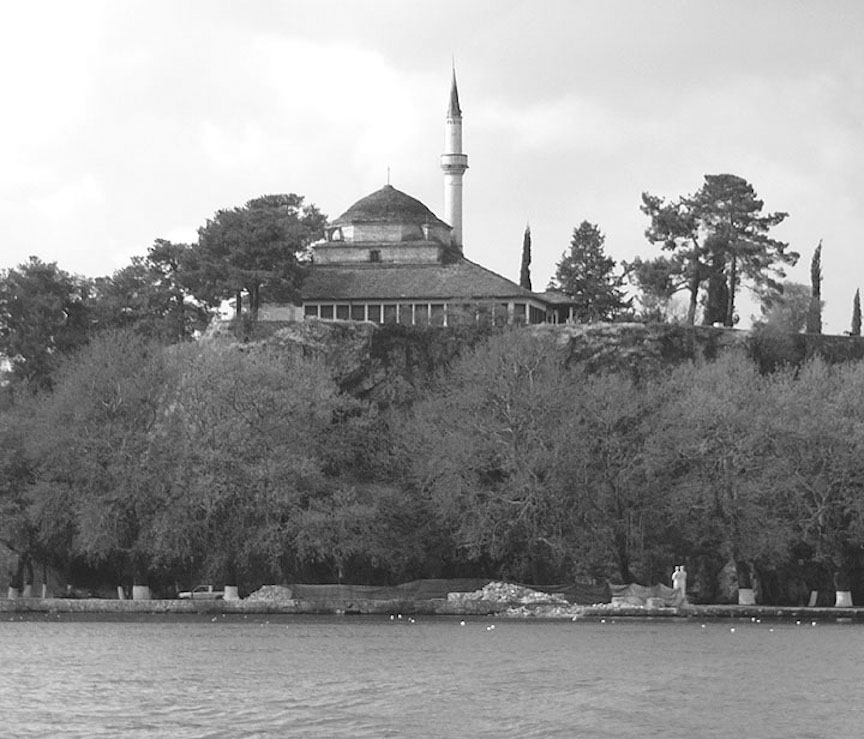


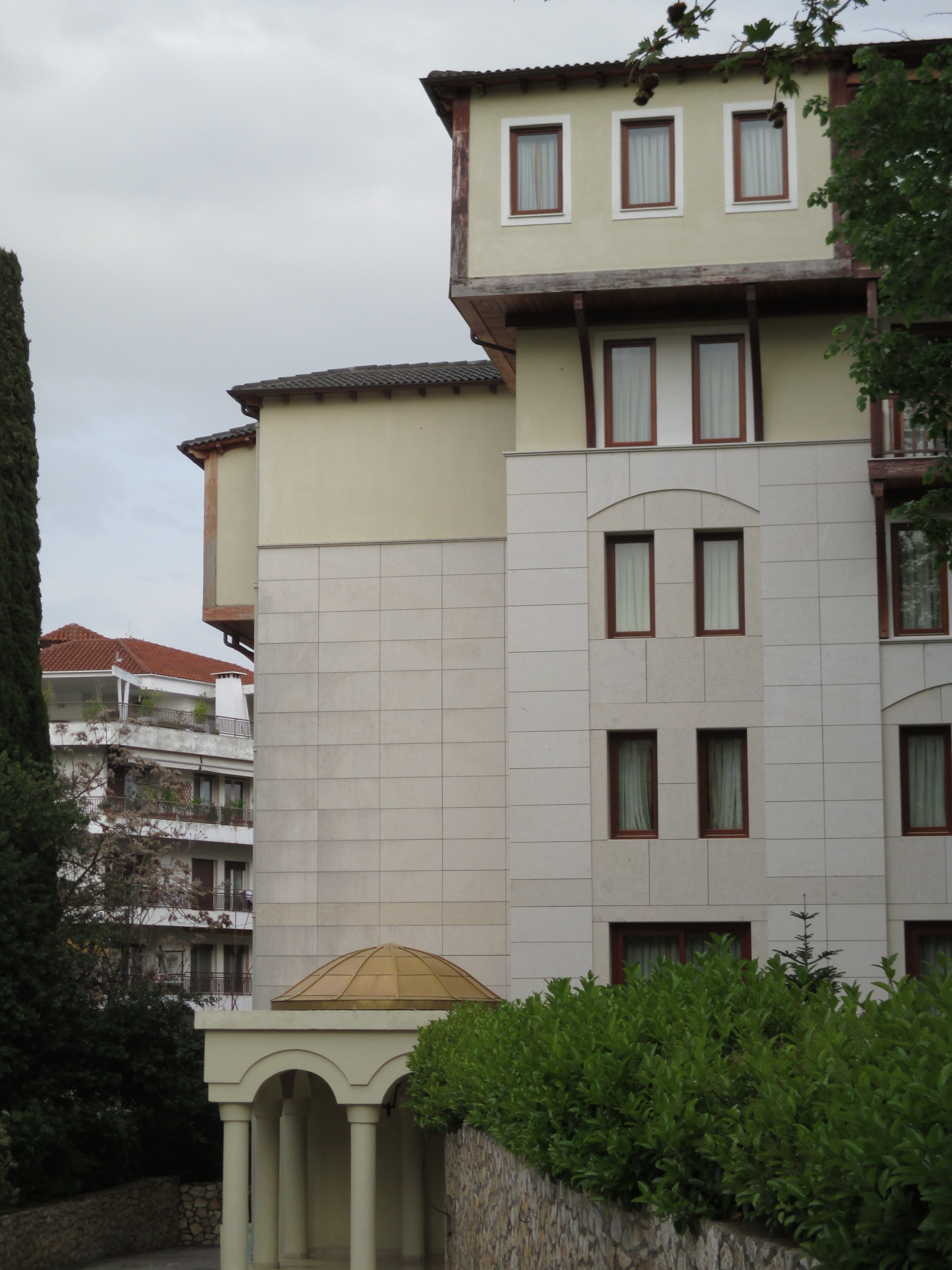


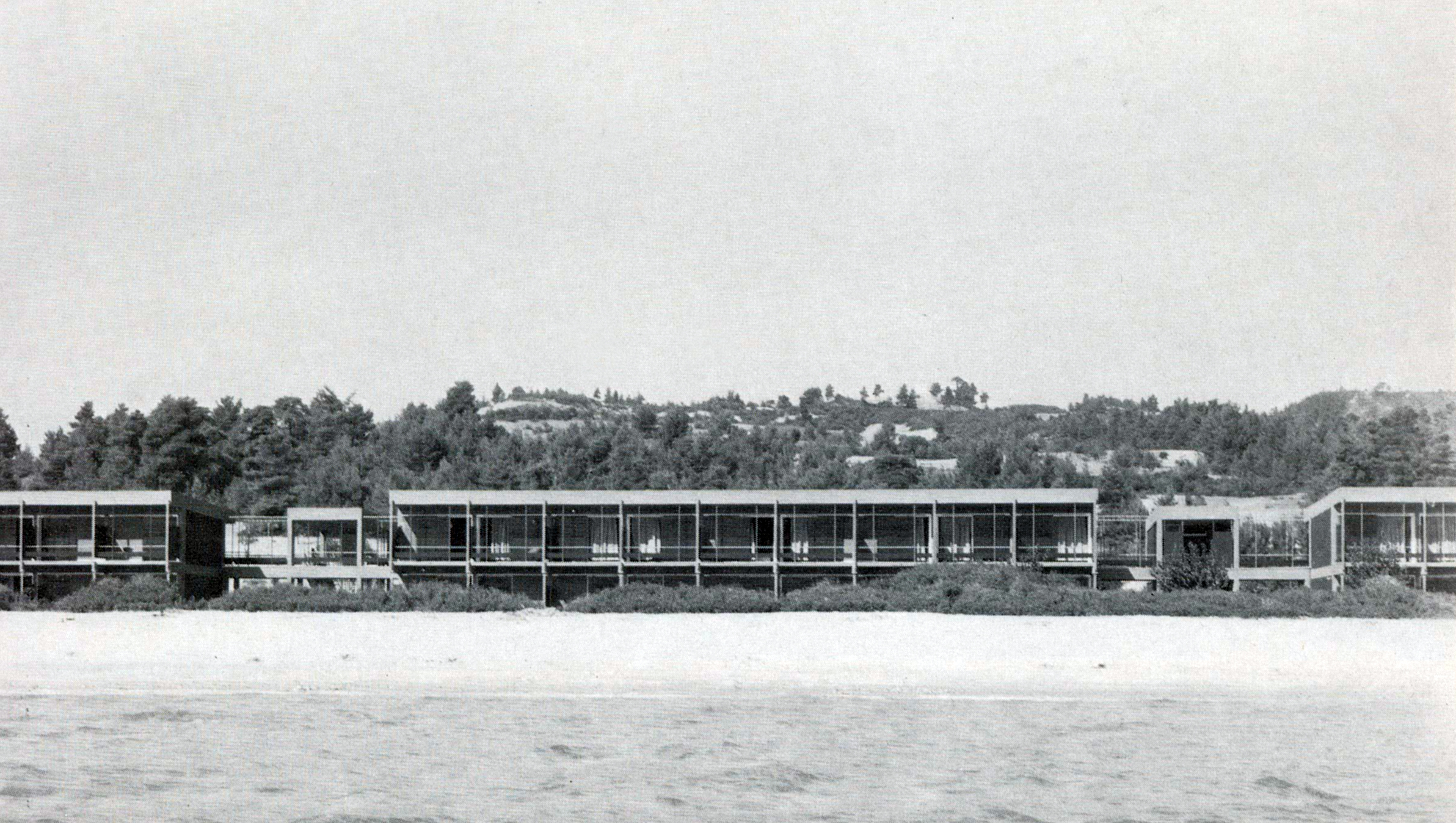


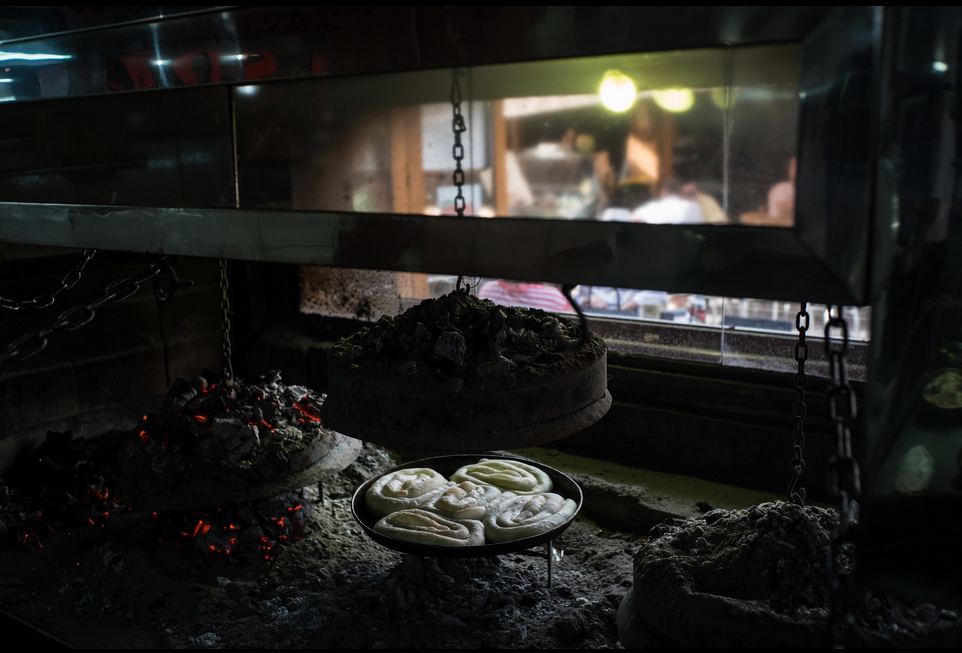


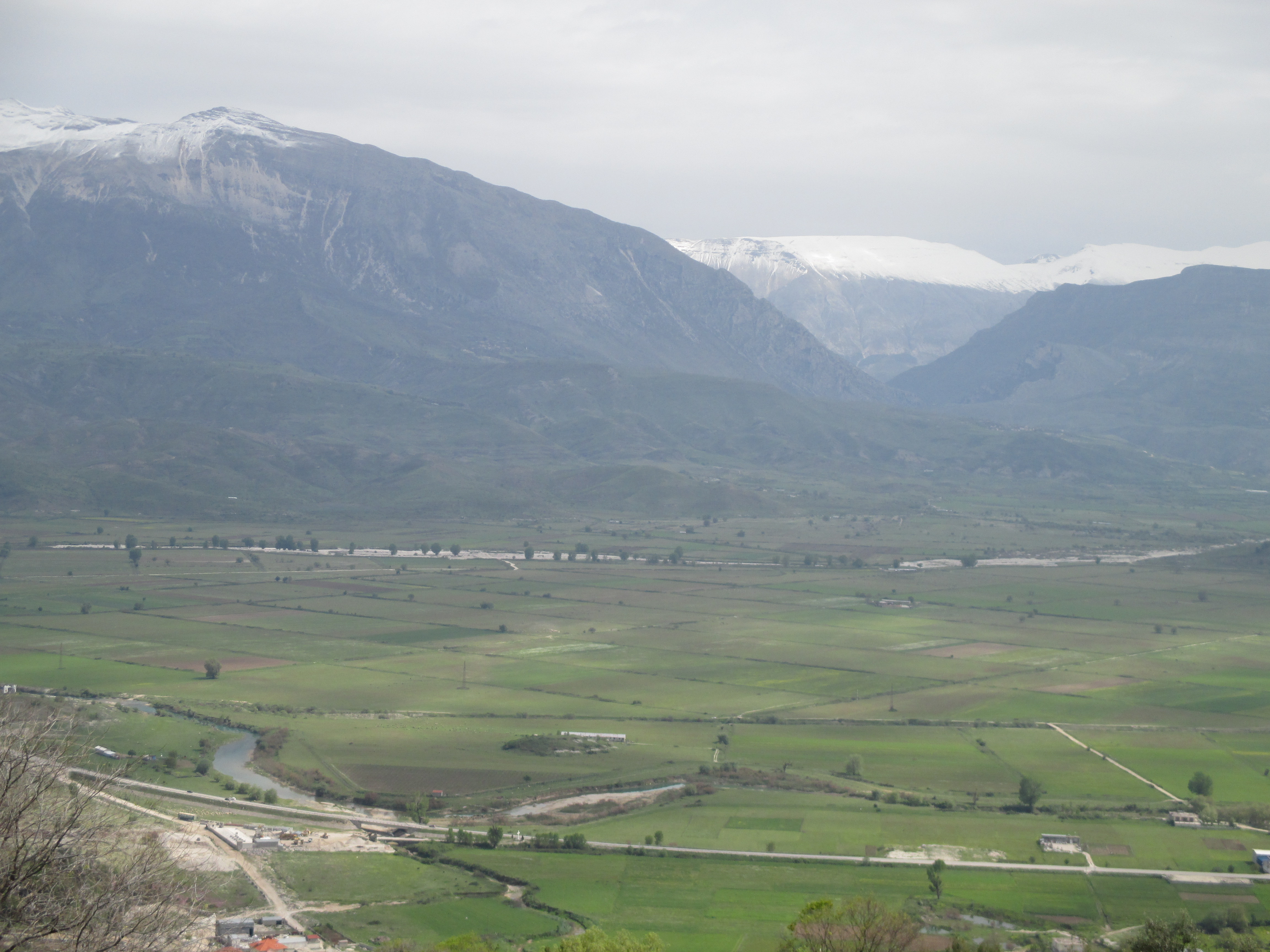
 Other money quotes:
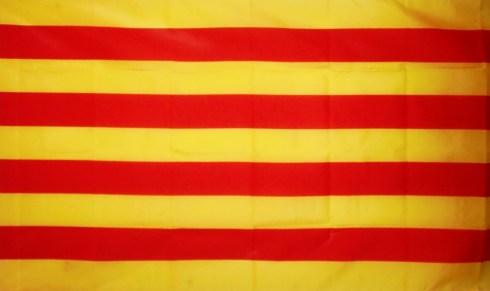 –
–



 Jadde: from Bosnia to Bengal